Gemini Omni 1.2 Flash Test: $1.05 per 15-Second Clip
We generated three dialogue clips with Gemini Omni 1.2 Flash over the API. A 15-second 720p clip cost $1.05 and took under 90 seconds, every scripted line came out word for word in English and Vietnamese, but 360p gave a different scene and one clip added a TV logo.
By the RanThis team, written with AI6 min read
Why trust this: every result, number and screenshot comes from a real run on our own accounts, not from the AI. How we test
Gemini Omni 1.2 Flash is worth using over the API for short dialogue clips: a 15-second 720p clip with two speakers cost us $1.05, took under 90 seconds, and every line matched the script word for word, even in Vietnamese. The catches: the cheap 360p "draft" was a different scene, and one clip came with a TV channel logo we never asked for.
Google released Gemini Omni 1.2 Flash on 5 November 2026 as a generally available video model on the Gemini API and Google Cloud, with clips up to 15 seconds (up from 10 in Omni 1.1) and a price Google puts at $0.07 per second of 720p. We generated three clips with the project's own API key the next day and priced each one from the usage field the API returned.
At a glance
Key results
- $1.05 for a 15-second 720p clip. The API billed 86,880 video output tokens, exactly 15 × 5,792, which is $1.04 at the $12 per million list price, plus about $0.01 of thinking tokens.
- 59 to 86 seconds to generate. The two 720p clips took 85.5 and 76.4 seconds per request; the 360p clip took 59.0 seconds.
- 360p costs a third, but it is a different take. The same prompt at 360p used 28,965 tokens ($0.36) and produced a different cast, room and whiteboard, so it does not work as a cheap preview of the 720p result.
- Dialogue came out as written. A separate model's transcript of each clip matched all three scripted lines, in the right speaker order, in English and in Vietnamese.
- Vietnamese text rendered correctly. A shop sign with stacked accents ("Phở Bò Gia Truyền – Mở cửa 6 giờ sáng") came out letter-perfect.
- An unrequested logo. The Vietnamese clip carried the logo of a real Vietnamese TV channel in the corner for all 15 seconds.
Hands-on test
Setup
- Date: 6 November 2026, Python script (httpx) on a Windows 11 PC in Vietnam (WSL, Ubuntu 24.04).
- Access: the project's own Gemini API key on a prepaid paid-tier AI Studio project. We have no Google AI Ultra plan, so this tests the API, not the Gemini app.
- Endpoint:
POST /v1beta/interactionswithmodel: gemini-omni-1.2-flashandresponse_formatset totype: video,duration: 15s,aspect_ratio: 16:9,delivery: uri, then the file download endpoint. Omni does not use the olderpredictLongRunningcall that Veo used. - Prompts: (1) two coworkers at a whiteboard reading "LAUNCH FRIDAY", three scripted English lines; (2) a Hanoi street-food stall with a Vietnamese sign and three scripted Vietnamese lines. Prompt 1 ran at 720p and 360p, prompt 2 at 720p.
- Checks: frame grabs every 3 seconds with PyAV, and a verbatim transcript of each clip from
gemini-3.8-flash(about $0.004 per clip), which was not shown the script. We checked words and on-screen text, not lip-sync by ear. - Total spend for the test: about $2.47.
720p vs 360p: price, speed and a catch
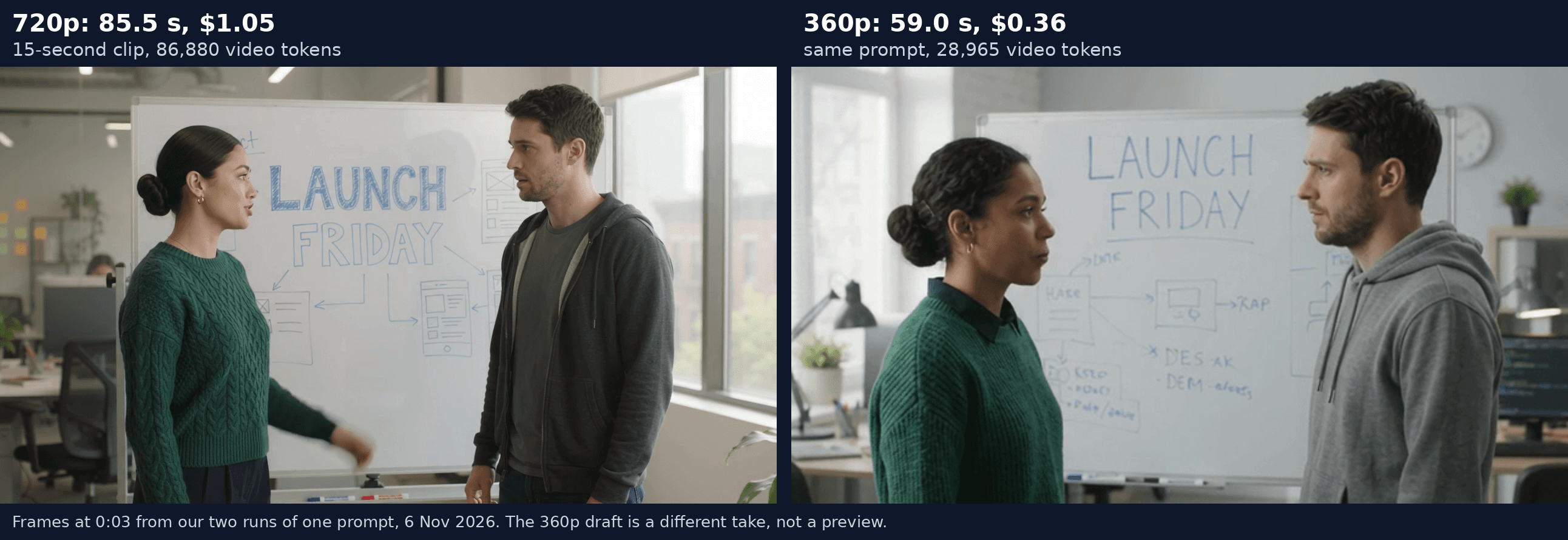
Google's announcement suggests you can "draft fast at 360p or 720p" and upscale the best result. The pricing page backs up the saving: 1,931 tokens per second at 360p against 5,792 at 720p, so $0.023 a second against about $0.07. Our 360p clip cost $0.36 and arrived 26 seconds sooner than the 720p one.
The catch is that a 360p run is a fresh generation, not a low-resolution version of the 720p clip. Ours had a different woman, a different hoodie, a different office and a whiteboard covered in invented words ("HARK", "DES AK"), while the 720p version kept the whiteboard close to what we asked for. If you draft at 360p, plan to upscale the draft you like (Google lists 1080p at $0.104 and 4K at $0.209 a second as upsampled outputs) rather than re-run the prompt at 720p and expect the same shot. We did not test upscaling.
Dialogue and Vietnamese text
All three clips said exactly what the prompt said. In the English clip the woman spoke first ("We still haven't tested the checkout page."), the man answered with the full 11-word line, and she closed with "Deal. Order pizza.", all inside 12 seconds and with a soft chuckle the prompt did not ask for. The Vietnamese clip did the same with a customer and a vendor, and the transcript kept every diacritic of all three lines. That goes beyond what Google promises: the developer docs say English is fully supported and "other languages have not been evaluated, so they may work but results can vary." Treat non-English speech as something to test in your own language, as we did.
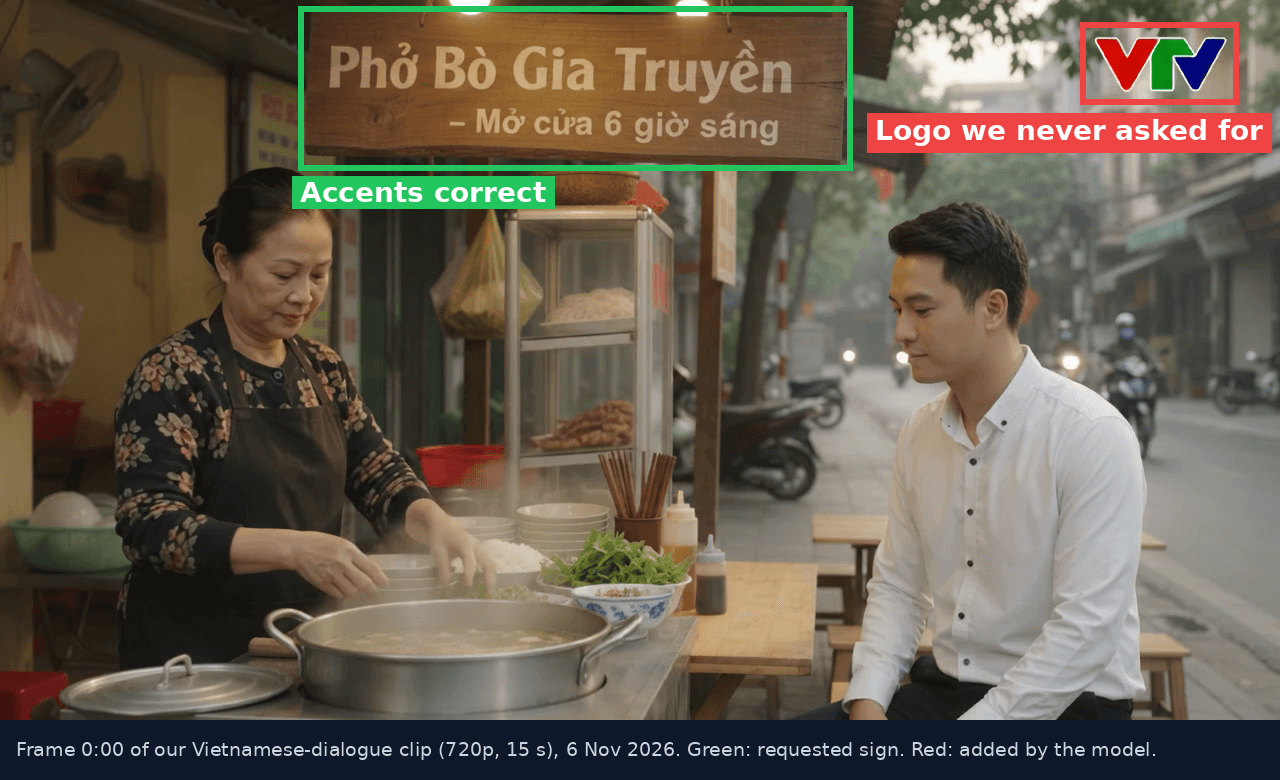
On-screen text was the stronger result. The sign with stacked Vietnamese accents was spelled perfectly and stayed stable for all 15 seconds. The problem is next to it: the model put the logo of VTV, Vietnam's national broadcaster, in the top right corner, as if the scene were a news segment. Our prompt mentioned no channel, logo or broadcast. For anything you publish, check every frame for trademarks, and say "no channel logo, no watermark, no on-screen branding" in the prompt. Separately, Google says every output carries an invisible SynthID watermark.
What worked
What worked
- Exact dialogue in English and Vietnamese, three lines per clip, in the right order.
- Exact Vietnamese sign text with stacked accents.
- Predictable cost: the token count was exactly 5,792 per second at 720p and 1,931 at 360p, so you can price a clip before you run it.
- No long-running operation to poll: the request itself waited 59–86 seconds and returned a reference to the finished file.
Where it fell short
What didn't work
- A real broadcaster's logo added to the Vietnamese clip without being asked for.
- 360p is not a preview of 720p: same prompt, different scene.
- Background text the prompt did not specify came out as invented words at 360p.
Our verdict
Use Gemini Omni 1.2 Flash over the API if you need short clips where people say specific lines: at $1.05 per 15 seconds of 720p, with the lines landing word for word, it is a practical way to make social clips and product explainers. Budget for retakes, though: the speech was reliable for us, but the scene and branding were not, and one in three of our clips would have needed a re-run because of the logo. Draft at 360p only to test an idea, then pick and upscale; don't expect a 720p re-run to match. If you prefer a monthly plan with credits to pay-per-second API billing, compare what Higgsfield's plans cost; for presenter-style videos with avatars, see our Synthesia free plan test.
FAQ
How much does Gemini Omni 1.2 Flash cost?
On the Gemini API, video output is $12 per million tokens. Google bills 5,792 tokens per second of 720p, about $0.07 a second, so a 15-second clip is about $1.04 plus a cent of thinking tokens in our test. 360p is $0.023 a second; 1080p and 4K upscaling are $0.104 and $0.209 a second.
How long can a Gemini Omni 1.2 Flash clip be?
From 3 to 15 seconds in one-second steps. The API returns an invalid argument error above 15 seconds. Omni 1.1 was limited to 10 seconds.
Can Gemini Omni speak languages other than English?
In our test it spoke three scripted Vietnamese lines exactly as written and rendered a Vietnamese sign correctly. Google's developer docs only promise full support for English and say other languages have not been evaluated.
Is Gemini Omni 1.2 Flash free anywhere?
Not on the API: the pricing page lists no free tier. Google says anyone with a Google account or Workspace subscription can make up to three 15-second videos a month in Google Vids at no cost. We did not test Vids.
What happens to Gemini Omni 1.1 Flash?
Google's pricing page says that from 3 December 2026 API requests to gemini-omni-1.1-flash are routed to 1.2 and billed at 1.2 rates.
Sources
- Google – Introducing Gemini Omni 1.2 Flash (5 Nov 2026)
Vendor page
- Google AI Studio docs – Gemini API pricing: Gemini Omni 1.2 Flash and 1.1 Flash rows (read 6 Nov 2026)
Vendor document
- Google AI Studio docs – Gemini Omni video generation with the Interactions API (read 6 Nov 2026)
Vendor document
- Google – Omni 1.2 Flash in Google Vids (5 Nov 2026)
Vendor page
- Google Cloud blog – Gemini Omni 1.2 Flash generally available (6 Nov 2026)
Vendor page