Should I Buy RAM Now? 32GB of DDR5 Is $475 at Best Buy
RAM prices are still rising because of AI demand, while SSD prices are forecast to fall from early 2027. US store prices per GB on 27 November and a daily price log show what to buy now and what to wait for.
By Duy Lam Le, written with AI7 min read
Why trust this: every result, number and screenshot comes from a real run on our own accounts, not from the AI. How we test
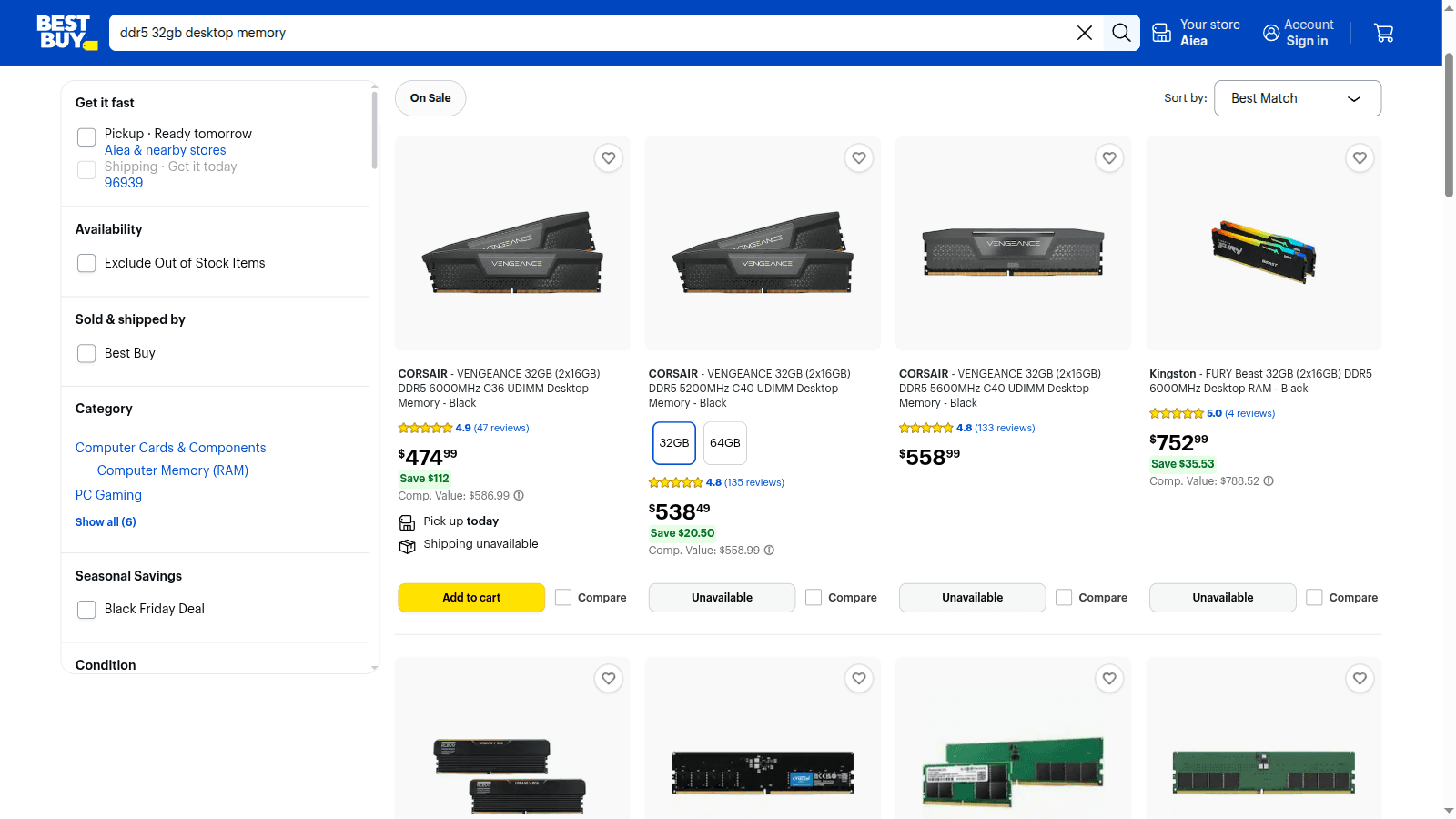
If you need more memory for a PC, mini PC or laptop that runs AI models locally, buy RAM now if you need it in the next few months, and wait on SSDs if you can. RAM prices are still rising, only more slowly, while NAND flash prices are forecast to fall from early 2027. On 27 November 2026, 32GB of DDR5 cost $474.99 at Best Buy.
- RAM is still getting more expensive. TrendForce forecasts PC DRAM contract prices, what memory makers charge PC brands and module makers rather than what you pay in a store, will rise 13–18% quarter over quarter in Q4 2026.
- SSDs turn first. TrendForce expects NAND flash contract prices to fall 0–5% in Q1 2027.
- DDR5 costs about 2.5 times as much per GB as the cheapest DDR4. On 27 November, DDR5 at Best Buy and Newegg cost $14.84–$20.78 per GB; the four cheapest DDR4 kits cost $7.19–$7.81.
- The Minisforum AI X1 Pro-470 got no price cut in the late-November sales. No version of this mini PC from our mini PC deals roundup got cheaper on its US store from 19 to 27 November.
Buy RAM before it gets more expensive: DRAM keeps rising into 2027
TrendForce's Q4 rise is "slowing from the previous quarter" for two reasons it names: PC makers' DRAM inventories have been rising since Q3 2026, and suppliers have "some flexibility to slightly moderate price increases". Neither makes RAM cheaper.
AI is also squeezing next year's PC supply: TrendForce writes that "robust demand from AI applications has led memory manufacturers to tentatively plan cuts to PC DRAM supply in 2027". Its 25 November outlook expects DRAM supply "to remain tight throughout 2027", with quarterly contract increases that "are projected to narrow progressively, potentially leveling off in the second half of the year." Leveling off means prices stop climbing, not that they fall back.
Or should you wait for prices to drop? Not on this forecast: contract prices do not turn into store prices overnight, TrendForce does not say how long the delay is, and while contract prices are still rising there is no reason to expect store prices to fall.
SSDs are the part worth waiting for
Storage runs on a different cycle from RAM. TrendForce expects client SSD contract prices to rise less than 5% in Q4 2026, has cut its Q4 forecast for NAND overall to an 8–13% rise, and reports that spot prices, the day-to-day market prices outside long-term contracts, have already corrected by "more than 20%". TrendForce says Q4 prices are being pulled down by repeated cuts to consumer electronics shipment forecasts and by Chinese cloud providers' "substantial cuts to enterprise SSD orders"; for 2027 it expects NAND supply growth to outpace demand, with "all product categories entering a downward cycle from 2Q27".
So Q1 2027 brings little relief: a 0–5% cut from Q4 2026 contract prices leaves NAND close to where it is now, and the bigger cuts are forecast from Q2 2027. If you need a drive now, buy it. TrendForce adds that its NAND outlook depends on how fast Chinese cloud providers work through their inventory and on US policy after the mid-term election, so treat the dates as a forecast, not a schedule.
2027 laptops may get weaker memory chips and less storage
The same pressure reaches finished devices. TrendForce reports notebook shipments fell 15.8% quarter over quarter in Q3 2026, and that some PC makers plan 2027 models with "lower-specification memory chips and CPUs with fewer cores". Its 25 November report adds that "device prices face upward pressure in 2027" and that brands are expected to reduce storage capacity to control costs.
So if you are buying a laptop in the next few months, today's configuration at a given price may be more generous than the 2027 model that replaces it. Many laptops also have RAM soldered to the board, so the memory you pick at checkout is the memory the laptop keeps.
In US stores, DDR5 costs about 2.5 times the cheapest DDR4 per GB
Those forecasts meet a store shelf where memory is already expensive. These are the prices of mainstream memory and SSDs on Best Buy and Newegg on 27 November 2026, with the price per GB worked out from the listed capacity.
The ratio runs from 1.9 times to 2.9 times, so the memory type your machine takes sets your budget: a DDR4 desktop can add 32GB for $230–$250, while a DDR5 desktop or laptop pays $475–$600 for the same 32GB.
A "Save" label says little about value: the Corsair DDR5 kit shows "Save $112" against a comparable value of $586.99 and still costs $14.84 per GB, about twice the $7.50 per GB of the Crucial 16GB DDR4 stick, which shows "Save $80" against $199.99. Within one type the spread is just as wide: the two 64GB DDR4-3200 kits cost $7.54 and $16.73 per GB, so the Crucial Pro DDR4 kit costs more per GB than the cheapest DDR5 kit.
The Minisforum AI X1 Pro-470 did not get cheaper in the late-November sales
The Minisforum AI X1 Pro-470, which Minisforum sells as a Copilot+ AI mini PC, shows the same thing in a finished machine: we read its US store prices at least once a day from 19 to 27 November, and none of them fell.
Four of the five versions sat 20% under their compare-at price on every reading. The only change was a rise: the 32GB + 2TB version read $1,463 from 24 November, widening the gap between the 1TB and 2TB versions from $82 to $136. At the last reading all five versions were listed as unavailable.
The table also prices the memory itself. Going from 32GB to 64GB with the same 1TB SSD costs $392, or $12.25 per GB, below every DDR5 kit in the store table above. The 96GB version works out to $9.63 per GB over the 32GB + 2TB version at its price from 24 November, but it was out of stock on every reading. When the machine is in stock, ordering more memory with it can cost less than adding memory later.
Buy now or wait: RAM now, SSD later, by situation
Before you pick a size, check which RAM your machine takes and which memory the model you want to run uses. On Windows, Task Manager → Performance → Memory shows how many slots are in use; the DDR type and speed are in CPU-Z or the maker's spec page. On a PC with a graphics card, the model runs from the card's VRAM; mini PCs like the AI X1 Pro-470 and Macs share system RAM with the GPU, so system RAM is what you are sizing. Nvidia's Nemotron 3.5 Bolt 74B-A9B, for example, is designed to fit in 24GB of memory with 2-bit quantization: a 24GB graphics card or a shared-memory machine with more than 24GB, not a 16GB PC.