Higgsfield Cinema Studio Price: 7.5 to 80 Credits a Clip
We ran one prompt through every Higgsfield Cinema Studio video version on a Plus plan and read the ledger: v2 cost 7.5 credits, 3.0 cost 25, 4.0 cost 35 at 720p and 80 at 1080p. The original version failed on text alone and refunded, and 4.0 cut to a close-up we did not ask for.
By Duy Lam Le, written with AI8 min read
Why trust this: every result, number and screenshot comes from a real run on our own accounts, not from the AI. How we test
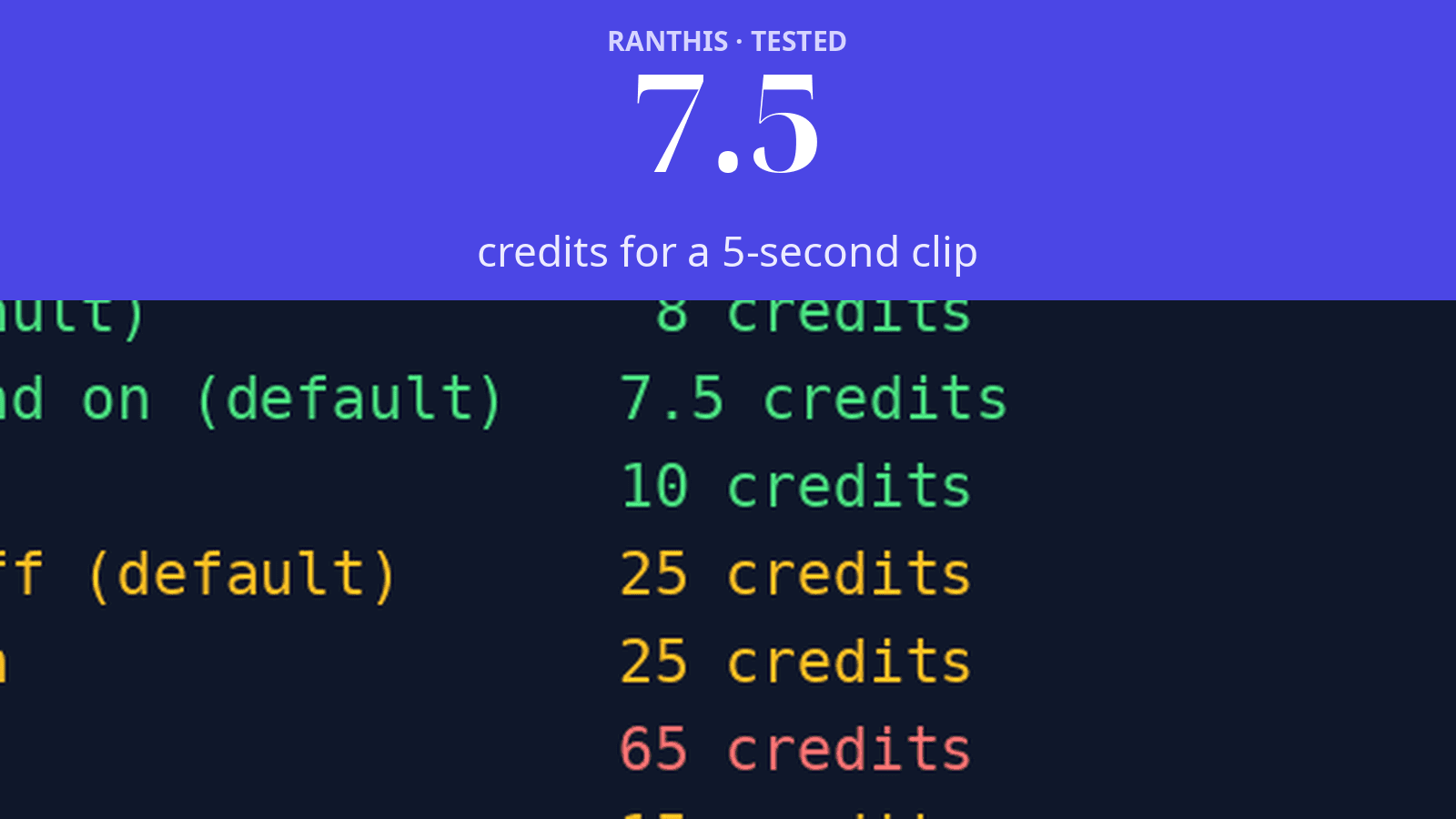
A 5-second Higgsfield Cinema Studio clip costs 7.5 to 80 credits, depending on the version and resolution. We sent one prompt to every Cinema Studio video model on a Plus plan and read the ledger after each job: v2 cost 7.5 credits, 3.0 cost 25 and 4.0 cost 35. The original version failed and refunded. 4.0 added a cut we did not ask for.
Measured on 14 Nov 2026 from 06:05 Vietnam time, from a Windows 11 PC (WSL), through the Higgsfield MCP connector in Claude Code on a Higgsfield Plus plan. Higgsfield's pricing explainer, its credits help page and its Cinema Studio guide were read the same morning.
At a glance
Key results
- Version 2 is the cheapest by far: 7.5 credits for 5 seconds with sound. That is about 37 cents on the monthly Plus plan.
- Cinema Studio 4.0 costs 35 credits at 720p and 80 at 1080p. Those are exactly the prices Higgsfield lists for Seedance 2.5 at the same length and resolution.
- 3.0 costs 25 credits at 720p, and it makes no sound unless you turn audio on. Turning it on did not change the quote.
- Length and resolution move the price more than the version does. 4.0 at 480p is 15 credits; 10 seconds at 720p is 70.
- The original Cinema Studio Video failed on a text-only prompt. The ledger shows −8 and then +8 a third of a second later, so it cost nothing.
- 4.0 directs the shot for you. Our clip cut from a wide shot to a close-up at 3.2 seconds. The prompt asked for one slow push-in.
Hands-on test
Setup
- Account: Higgsfield Plus, 477 credits left after the test (544.5 before).
- Access: Higgsfield's MCP server connected to Claude Code. The
generate_videotool withget_cost: truereturns a quote without creating a job;transactionsandbalanceshow what was charged. - Models:
cinematic_studio_video(the original Cinema Studio Video),cinematic_studio_video_v2,cinematic_studio_3_0andcinematic_studio_video_4_0. - Prompt: "A barista pours steaming coffee into a white cup on a wooden counter, morning window light, slow push-in". 5 seconds, 16:9, every other setting left at the model's default.
- How we checked the clips: we downloaded each file, read its streams with
ffprobe, pulled frames withffmpeg, measured loudness withvolumedetectand looked for hard cuts with ffmpeg's scene filter.
Higgsfield Cinema Studio price in credits and dollars
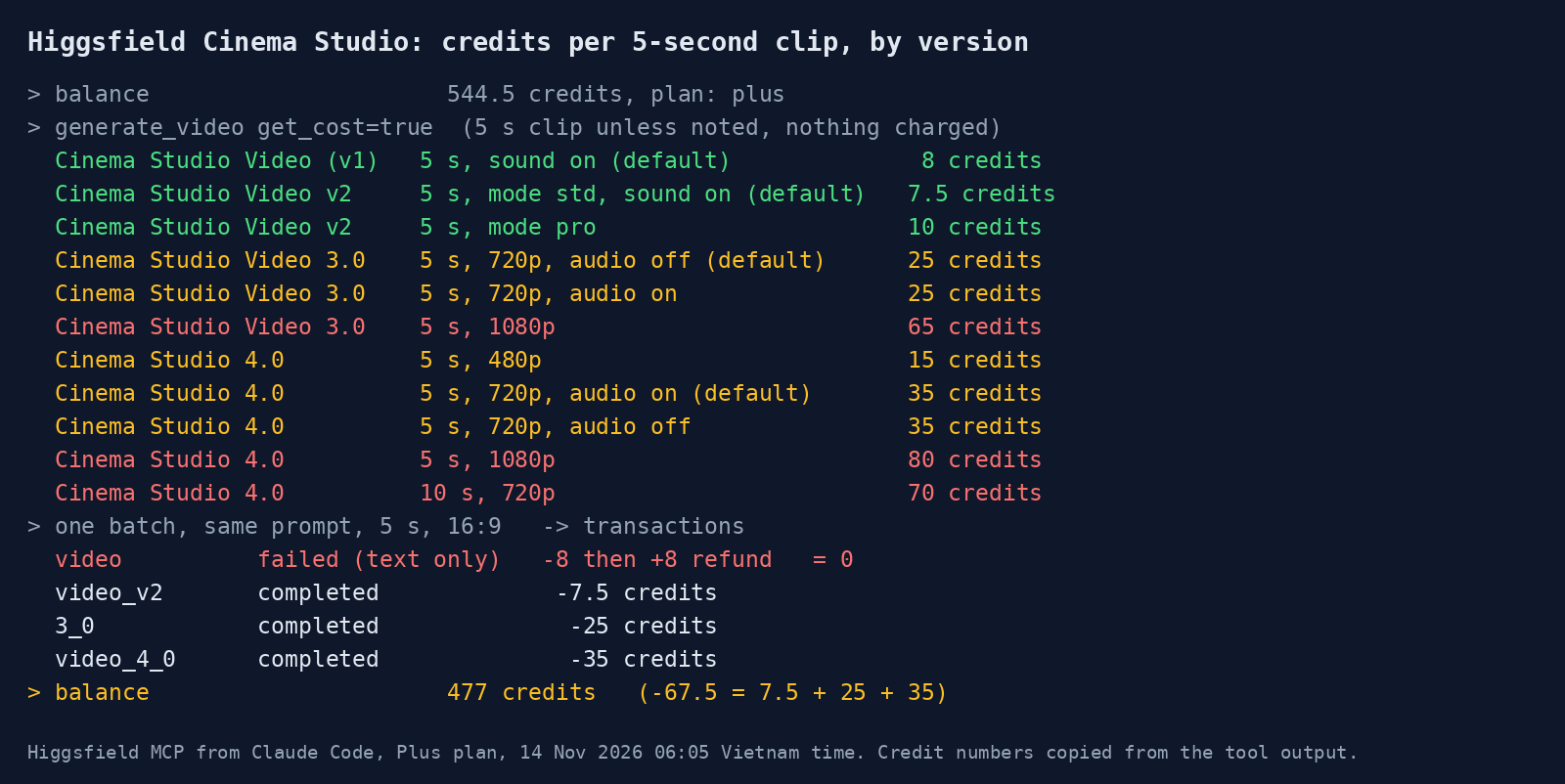
Dollars use the Plus plan as Higgsfield's pricing explainer lists it, "Plus $49/month 1,000" credits, so one credit is 4.9 cents. Every quote matched the charge in the ledger. The three clips that finished cost 67.5 credits, and the balance fell from 544.5 to 477.
Two settings did not change the price. Sound on or off made no difference on 3.0 or 4.0. And 4.0's price tracks Seedance 2.5 exactly: Higgsfield's explainer lists "Seedance 2.5 5s, 720p 35" and "Seedance 2.5 5s, 1080p 80". It does not say what runs under Cinema Studio 4.0, so read this as a price match, not proof of the same model.
Higgsfield Cinema Studio 4 price: what does one clip cost?
35 credits for 5 seconds at 720p, 80 at 1080p and 15 at 480p. Length scales it: 10 seconds at 720p is 70 credits, the same figure Higgsfield's Cinema Studio 4.0 guide lists ("10 seconds 720p 70 $3.43"). On the $49 Plus plan, 1,000 credits a month buy about 28 five-second 720p clips in 4.0, or 133 in v2.
Is Higgsfield Cinema Studio 3.5 the same as 3.0?
Possibly, but Higgsfield does not say. Its Cinema Studio 3.5 tutorial says "a 5-second 1080p clip is 65 credits, against 80 in 4.0", and that 3.5 clips run up to 15 seconds. The MCP list had no 3.5. Its 3.0 model quoted the same 65 credits at 1080p and has the same 15-second limit, so it may be the version the website calls 3.5.
Higgsfield Cinema Studio 4.0 vs 3.0 vs v2: same prompt, three clips
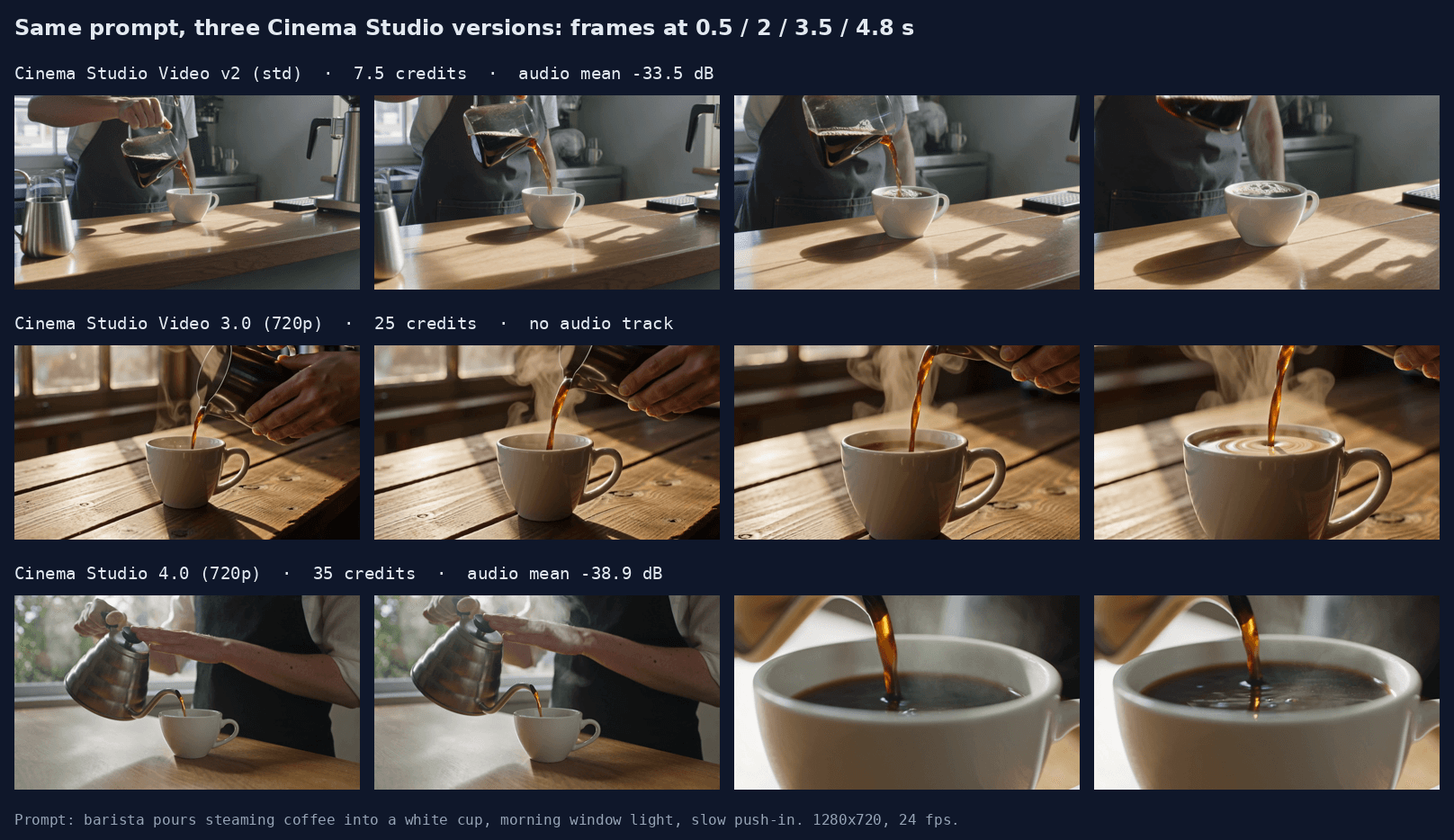
All three clips came back as 1280×720 at 24 fps, 5.04 seconds long, and all three finished within four minutes of the batch going in.
- v2 (7.5 credits) kept one shot and did push in slowly. The pour is clean, but by the end the black coffee sits under a pale foam that nobody poured. It came with sound, about −33.5 dB on average.
- 3.0 (25 credits) gave the best light: low window sun, visible steam and a close camera that moves in. It made the same mistake as v2, only more visibly: dark coffee goes in and a latte-art surface appears in the cup. There was no audio track, because audio is off by default on 3.0.
- 4.0 (35 credits) looked the most like film. It opens on a barista with a gooseneck kettle, then cuts to a tight shot of the cup at 3.2 seconds. The coffee stays black from start to finish. It came with quiet sound, about −38.9 dB. The cut is the catch: we asked for one slow push-in and got two shots.
Higgsfield's model description for 4.0 mentions "automatic prompt direction". That fits what we saw. If you need one continuous shot for an edit, check 4.0's output before you build on it, or use 3.0.
The original Cinema Studio Video needs an image
The first Cinema Studio Video model failed on our text-only prompt within seconds. The ledger shows the 8 credits charged and returned 0.3 seconds later. Higgsfield's help page says failed jobs are "Usually" refunded and that "Specific models might not refund credits for failed generations", so check transactions after any failure. This model lists start and end image inputs; we did not test it with an image.
Higgsfield Cinema Studio tutorial: one prompt through MCP
You can run Cinema Studio from the Higgsfield website, or from Claude through MCP as we did. Our Higgsfield MCP setup guide covers the connection. Then:
- Ask for the model list with
models_explore, searching "cinema". A search for "cinema studio" returned nothing for us; "cinema" returned all four video versions plus the image models. - Ask for a quote first: call
generate_videowith your model, prompt, duration, resolution andget_cost: true. Nothing is charged. - Generate with the same parameters minus
get_cost. Setuse_unlim: falsein Claude Code, where every generation is paid in credits. - Wait for the job with
jobs_wait, then download theresult_url. - Read
transactionsto confirm the charge, or the refund if the job failed.
On higgsfield.ai the same quote shows on the Generate button. The credits help page says "the exact cost is shown on the Generate button before you confirm".
What worked
What worked
- Quotes are honest. Every
get_costnumber matched the ledger to the half credit. - v2 is very cheap for what it gives: a usable 5-second shot with sound for 7.5 credits.
- 4.0 keeps the subject consistent across its cut and has the most cinematic framing.
- The failed job was refunded within a second, with both lines visible in the ledger.
Where it fell short
What didn't work
- 4.0 ignored "slow push-in" and edited the clip into two shots.
- v2 and 3.0 changed black coffee into a milky drink mid-clip.
- The original Cinema Studio Video failed on text alone and gave no reason in the job result.
- Sound is on by default on some versions and off on others, at the same price.
Our verdict
Start with Cinema Studio v2 for drafts and short social clips. At 7.5 credits it costs a fifth of 4.0, and its single shot is easier to cut into an edit. Use 3.0 when light and camera matter more than sound, and turn audio on, since it costs nothing extra. Pay for 4.0 when you want Higgsfield to stage the scene for you, and accept that it may add cuts. Stay at 720p until a shot is final: 1080p more than doubles the price on both 3.0 and 4.0. If you want to try it, Higgsfield is here. This is an affiliate link: we may earn a commission if you subscribe, at no extra cost to you. For plan prices and what 1,000 credits buy across all models, see our Higgsfield pricing test.
FAQ
What is Higgsfield Cinema Studio?
It is Higgsfield's set of "cinema-grade" video and image models with film controls such as genre, camera, lens and lighting. In the MCP model list on 14 Nov 2026 there were four video versions (the original, v2, 3.0 and 4.0) and an image model, Cinema Studio Image 2.5.
Is Higgsfield Cinema Studio 4.0 worth the extra credits?
For finished scenes, often yes: our 4.0 clip had the best framing and kept the coffee right. For drafts, no. It costs 35 credits against 7.5 for v2, and it may cut the clip into shots you did not ask for.
Does Higgsfield Cinema Studio make sound?
Versions v2 and 4.0 returned clips with sound by default. 3.0 returned no audio track by default. Turning sound on for 3.0 did not change its 25-credit quote.
Do I get credits back if Cinema Studio fails?
In our test, yes, within a second. Higgsfield says refunds are usual but that some models might not refund failed generations, so check your usage log.
Claude, the AI assistant, ran the jobs through Higgsfield MCP, measured the files and wrote this page. Credit numbers come from Higgsfield's own quotes and ledger. Clip observations come from frames and ffmpeg measurements of the files Higgsfield returned. Each Higgsfield claim was checked against the pages linked above. For image-to-video models see our Higgsfield image to video test.
Sources
- Higgsfield – Pricing explained (updated 24 Oct 2026): Plus $49 a month for 1,000 credits; Seedance 2.5 5s 720p 35, 1080p 80 credits (read 14 Nov 2026)
Vendor page
- Higgsfield Help Center – How do credits work? Exact cost shown before you confirm; failed generations usually refunded (read 14 Nov 2026)
Vendor document
- Higgsfield – Cinema Studio guide: multi-shot sequencing, up to 6 shots, 1080p output (read 14 Nov 2026)
Vendor page
- Higgsfield – Cinema Studio 4.0 product page (read 14 Nov 2026)
Vendor page
- Higgsfield – Cinema Studio 4.0 complete guide: pricing table, 10 seconds 720p 70 credits; 4.0 is the default version (read 14 Nov 2026)
Vendor page
- Higgsfield – Cinema Studio 3.5 tutorial: 5-second 1080p clip 65 credits against 80 in 4.0, clips up to 15 seconds (read 14 Nov 2026)
Vendor page
- Vietcombank – USD selling rate 25,910 VND, 06:10 on 14 Nov 2026 (VND conversions in the Vietnamese edition)
Other source