Claude Fable 5.2 vs Opus 5.5: Perfect Score at 2.6x the Cost
We re-ran three sealed office tests (a trap-filled spreadsheet, a long contract and a month-end close with tools) on Claude Fable 5.2, Opus 5.5 and Sonnet 5.5 through the API. Fable 5.2 scored 10/10 in all 18 runs; it cost 2.6 times Opus 5.5 at default effort and 1.7 times at medium.
By the RanThis team, written with AI10 min read
Why trust this: every result, number and screenshot comes from a real run on our own accounts, not from the AI. How we test
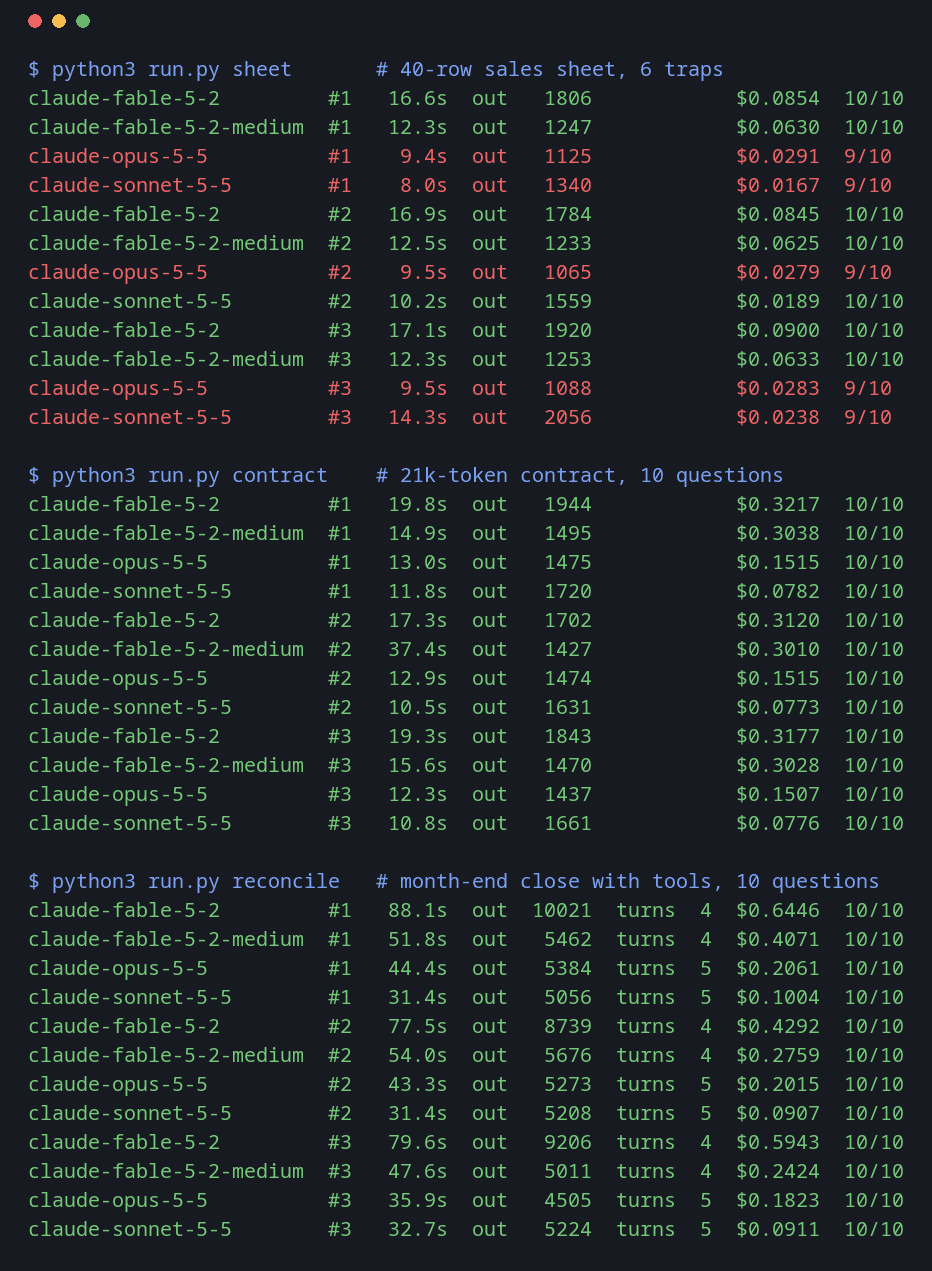
Claude Fable 5.2 was the only model that never dropped a point in our three office tests, and at its default settings it cost 2.6 times as much as Opus 5.5 for the same jobs (1.7 times at medium effort). Sonnet 5.5 cost half as much as Opus and lost the same single point in two of three spreadsheet runs.
Anthropic released Fable 5.2 on 9 November 2026 at $8 per million input tokens and $40 per million output tokens, down from $10/$50 for Fable 5.1. Its launch post says Fable 5.2 matches or beats Opus 5.5 at a fraction of the cost per task, but those comparisons put Opus 5.5 at its highest effort setting, while its API default is medium. So on 10 November we re-ran three office tests we had already sealed for earlier articles, through the Anthropic API from a Python script, with every model at its default setting and Fable 5.2 also at medium effort. The questions, answer keys and scoring code were committed before any model was called, in October, and were not changed. The data in all three tests is invented.
At a glance
Key results
- Accuracy: Fable 5.2 scored 10/10 in all 18 of its runs (9 at default effort, 9 at medium). Opus 5.5 scored 9/10 in all three runs of the spreadsheet test and 10/10 everywhere else. Sonnet 5.5 scored 9, 10 and 9 on the spreadsheet and 10/10 everywhere else.
- The one point that separated them is a judgement call, not a mistake anyone would notice by eye. Details below.
- Cost for all three jobs (sum of medians): Fable 5.2 at default effort $0.997, Fable 5.2 at medium $0.642, Opus 5.5 $0.382, Sonnet 5.5 $0.188.
- Speed: Sonnet and Opus were the fastest. On the agentic job the median run took 31 s for Sonnet, 43 s for Opus, 52 s for Fable at medium and 80 s for Fable at default effort.
- Fable 5.2 against Fable 5.1: about 16% cheaper on every job, and it fixed the one point Fable 5.1 lost on the contract test. On the agentic job it finished in 4 model turns instead of 6 to 18.
- Medium effort only saves money when the model writes a lot. It cut Fable's median cost by 54% on the agentic job (37% comparing first runs only, before caching helped) but only by 5% on the long contract, where the 30,496 input tokens are most of the bill.
- What we did not test: coding, Opus 5.5 or Sonnet 5.5 at higher effort, Fable 5.2 at low or xhigh effort, fast mode, the Claude apps and Claude Code, or Mythos 5.2.
Hands-on test
Setup
- Date and access: 10 November 2026, Anthropic Messages API, a Python script on a Linux PC. Three runs per model per test, run in turns (Fable, Fable medium, Opus, Sonnet, then again).
- Models and settings:
claude-fable-5-2at the API default (efforthighaccording to Anthropic's models overview),claude-fable-5-2withoutput_config.effortset tomedium,claude-opus-5-5at its API default (medium) andclaude-sonnet-5-5at its API default (high; the Claude apps and Claude Code use medium for Sonnet). No other parameters changed;max_tokenswas 32,000 so no model was cut short while thinking. - Test 1, spreadsheet (one request): a 40-row quarterly sales sheet for three branches with six planted problem rows: one order entered twice (two rows), a date that does not exist (31 September), a price written "1.2k", a branch written "SF" and a negative quantity. The model returns branch totals, the top branch and every abnormal row. Ten points: three exact totals, the top branch and one point for each planted problem row, minus one for each clean row flagged. First used in our GPT-6.1 Terra spreadsheet test.
- Test 2, long contract (one request, about 30,500 input tokens): a services contract with schedules, a data processing addendum and four amendments, and ten questions an office worker would ask before a budget meeting. Traps include a fee rise that a later amendment deletes, an unsigned draft amendment and a question the contract does not answer. We used the plain version of the prompt, which gives no hint about amendments or precedence. First used in our GPT-6 Astra long contract test.
- Test 3, month-end close with tools (agent loop): three CSV exports (140 invoices, a bank statement and a card processor report) that the model can only read through a
read_filetool, 25 lines per call, plus a calculator tool. Ten questions with ten traps. Prompt caching on. First used in our Fable 5.1 agentic test. - Scoring: by code, not by an AI judge, with the scoring files sealed in October.
- Cost: tokens from each API response's
usagefield × Anthropic's list price on 10 November. Per million tokens: Fable 5.2 $8 input, $40 output, $10 for 5-minute cache writes, $0.20 for cache hits; Opus 5.5 $4, $20, $5, $0.20; Sonnet 5.5 $2, $10, $2.50, $0.10. Output tokens include thinking. The 36 runs cost $6.61 in total.
The results
Medians of three runs. Scores show all three runs.
The Fable 5.1 row comes from the same sealed tests run two weeks earlier for our earlier articles, at Fable 5.1's price of $10/$50. It is there to show what changed between versions, not as a same-day comparison.
The one point that separated them
Every model found all six planted rows in the spreadsheet in every run. The lost point was the Chicago total, and it came from one row: nine filing cabinets at a unit price written "1.2k".
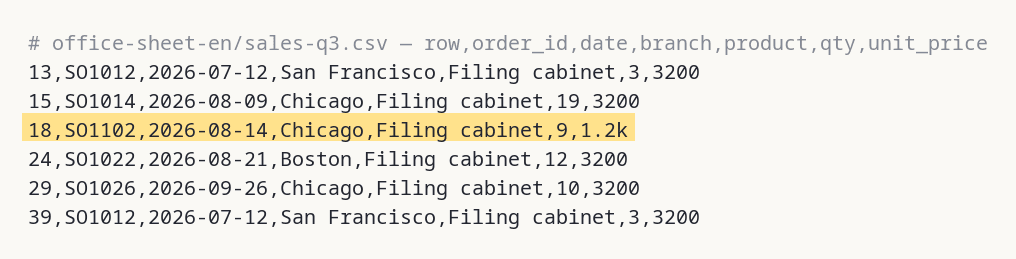
The prompt says to count rows that are "only written differently (an abbreviation, another name for the same branch or the same price)" and to leave out rows "that look like bad data". Our sealed answer key reads "1.2k" as a shorthand for $1,200 and counts it. Fable 5.2 did that in all 18 runs. Opus 5.5 left the row out in all three runs, with this reason: "The unit price '1.2k' means 1200, which does not match the standard Filing cabinet price of 3200, so the row is treated as bad data and excluded." Sonnet 5.5 did the same in two of three runs.
That is a defensible reading. Every other filing cabinet in the sheet costs $3,200, so a reviewer could argue Opus was the more careful one. What the result does show is that Fable 5.2 followed the written rule every time, and Opus and Sonnet overrode it with their own judgement. Fable 5.1 lost the same point in one of its three runs in October.
The contract test, which Fable 5.1 failed on question 10 in all three of its runs, did not separate anyone this time. Question 10 asks for the penalty for a late onboarding report, and the contract sets none. Fable 5.1 answered 0, which our key does not accept. Fable 5.2, Opus 5.5 and Sonnet 5.5 all answered that no penalty is stated.
Where the money goes
Long documents: you pay for input. The contract is 30,496 input tokens. At $8 per million that is $0.244 per Fable 5.2 call before it writes a word, against $0.122 on Opus 5.5 and $0.061 on Sonnet 5.5. All four settings wrote 1,400–1,950 output tokens, so medium effort saved Fable only about 5% here.
Agent loops: you pay for output and turns. On the month-end close, Fable 5.2 at default effort wrote a median 9,206 output tokens, mostly thinking, against medians of 5,273–5,462 for the other three settings. That is where medium effort cut its cost by more than half. All four settings read every line of all three files. Fable 5.2 asked for several pages at once and finished in 4 turns, Opus and Sonnet in 5. Fable 5.1 had read one page per turn in one of its October runs (18 turns) and finished the other two in 6.
Caching moves the numbers. In the agent loop, the cost of a run depends on how much of the conversation is already in the cache. Fable 5.2 at medium cost $0.41 in its first run and $0.28 and $0.24 in the next two, because they re-used a prefix cached a few minutes earlier by the same model. Anyone running the same job repeatedly will see the same effect, but a single run can cost noticeably more than our medians.
What worked
What worked
- Fable 5.2 followed the written instructions exactly in all 18 runs, including the one rule the other models chose to override.
- Fable 5.2 is cheaper than Fable 5.1 per task, not only per token: the same three jobs cost $0.997 at default effort against $1.19 for Fable 5.1, and $0.642 at medium.
- Setting
output_config.efforttomediumon Fable 5.2 kept the score at 10/10 and cut time and cost on every job. - Sonnet 5.5 handled the long contract and the 140-invoice close perfectly, at a quarter (contract) and a sixth (close) of Fable's default cost.
Where it fell short
What didn't work
- Our tests are too easy to separate the models on accuracy. Two of three gave every model 10/10, and the third turned on one ambiguous row. Anthropic's own claims are about much harder work (agentic coding, research tasks), and we did not test that.
- Anthropic's launch post compares Fable 5.2 at low, medium or high effort with Opus 5.5 at its maximum effort. We did not run Opus at maximum effort, so we cannot confirm or refute those cost claims. At default settings, Fable 5.2 was never cheaper than Opus 5.5 in our tests.
- Three runs per setting is enough to see a 2× cost gap, but not to give a reliable spread for time, which varied with API load (one Fable medium contract run took 37 s against 15–16 s for the other two).
Our verdict
For everyday office work through the API (reading a contract, checking a sheet, closing a month), start with Sonnet 5.5: it matched Opus 5.5 at half the price, and both scored 10/10 on two of our three jobs. Pay for Fable 5.2 when following your written rules to the letter matters more than the extra $0.45 it cost over Sonnet at medium effort for these three jobs, and when you use it, set effort to medium: in our tests it gave the same perfect score as the default for a third less money. Opus 5.5 at its default setting sat in the middle and did not win any job on accuracy or cost.
FAQ
How much does Claude Fable 5.2 cost?
$8 per million input tokens and $40 per million output tokens on the Claude API, according to Anthropic's pricing page, read on 10 November 2026. Cache hits cost $0.20 per million and 5-minute cache writes $10 per million. Fast mode costs $16/$80. Fable 5.1 was $10/$50.
Is Fable 5.2 cheaper than Opus 5.5?
Not per token: Opus 5.5 costs $4/$20. Per task, Anthropic says Fable 5.2 can match Opus 5.5 at its maximum effort for less money. In our three office tests at default settings, Fable 5.2 cost 2.6 times as much as Opus 5.5, or 1.7 times at medium effort.
What is the API model ID for Fable 5.2?
claude-fable-5-2. Anthropic's models overview lists its default effort on the API as high. The launch post says medium is the default in the Claude apps and Claude Code.
Did Fable 5.2 make any mistakes?
None in our 18 runs. Opus 5.5 and Sonnet 5.5 lost one point on the spreadsheet test by excluding a row that the instructions said to count, a choice they explained in their answers.
Can I run these tests myself?
The prompts, answer keys and scoring code are fixed files, and the cost formula is tokens × list price. Your costs will differ with caching, effort settings and the length of your documents, so use our medians as a rough guide, not a quote.
Sources
- Anthropic – Claude Fable 5.2 and Mythos 5.2 launch post: $8/$40 per million tokens, up to 30% faster than Fable 5.1, start with Opus 5.5 (read 10 Nov 2026)
Vendor page
- Claude Docs – Pricing: Fable 5.2 $8/$40, Opus 5.5 $4/$20, Sonnet 5.5 $2/$10 per 1M tokens; cache write and cache hit prices (read 10 Nov 2026)
Vendor page
- Claude Docs – Models overview: API ID claude-fable-5-2, default effort high (Opus 5.5 medium, Sonnet 5.5 high) (read 10 Nov 2026)
Vendor document