Claude Fable 5.1 Agent Test: Sonnet Tied It at 1/8 the Cost
We gave Claude Fable 5.1, Opus 5.5 and Sonnet 5.5 the job Anthropic sells Fable for: a long agentic month-end close with tools, three exports and ten traps. All three found every trap; Fable cost the most and was the slowest.
By the RanThis team, written with AI9 min read
Why trust this: every result, number and screenshot comes from a real run on our own accounts, not from the AI. How we test
Claude Fable 5.1 is not worth its price for a month-end close with tools. We gave Fable, Opus 5.5 and Sonnet 5.5 three exports and ten traps; all three closed the books correctly, and Fable cost the most and took the longest.
Anthropic sells Fable "for demanding reasoning and long-horizon agentic work", at $10/$50 per million tokens: 2.5 times the list price of Opus 5.5 and five times Sonnet 5.5. So we tested exactly that kind of job: paging through an invoice list, a bank statement and a card report, and matching every payment to an invoice. Finance teams do this at every month end, and AI agents are now pitched for it. We measured it on 28 Oct 2026 through the Anthropic API, from a Python script. The data is invented. The prompt, the answer key and the scoring code were committed before any model was called, and the raw logs of every run are kept with this article's source files.
At a glance
Key results
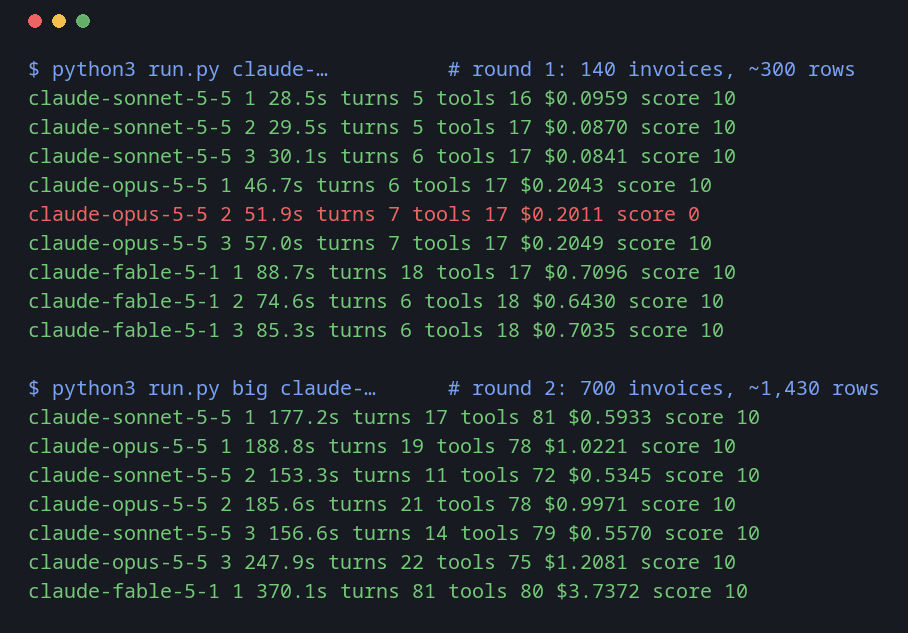
- All three models found all ten traps. In round 1 (140 invoices) Fable 5.1, Opus 5.5 and Sonnet 5.5 gave the right answer to every question in every run. The one exception was a formatting slip: one Opus run sent two JSON objects. In round 2 (700 invoices, about 58 page reads), every run of every model again scored 10/10.
- Cost per month-end close, round 1 (median): Sonnet 5.5 $0.087, Opus 5.5 $0.20, Fable 5.1 $0.70. Same answers, an 8× spread.
- Round 2 (median): Sonnet 5.5 $0.56, Opus 5.5 $1.02, Fable 5.1 $3.74 (one run). Sonnet was also the fastest in both rounds: 30 s and 2.6 minutes, against 85 s and 6.2 minutes for Fable.
- Fable worked one page at a time. In round 2 it made 80 tool calls over 81 model turns, one file page per turn. Sonnet and Opus asked for 8–10 pages at once and finished in 11–22 turns. Each turn re-sends the whole conversation, so Fable's run re-read 3.8 million cached tokens; the median Sonnet run re-read 0.6 million and the median Opus run 0.8 million.
- Prompt caching is what made Fable affordable here. At the full input price, those 3.8 million re-read tokens alone would have cost about $38 instead of $0.94.
- What we did not test: Fable at a lower effort setting, Opus 5.5 at high effort, the Claude apps (claude.ai, Claude for Excel), real bank formats, or files the model has to open itself. This is one invented month, ten questions with fixed answers, and three runs per model per round (one Fable run in round 2, see Setup).
Hands-on test
Setup
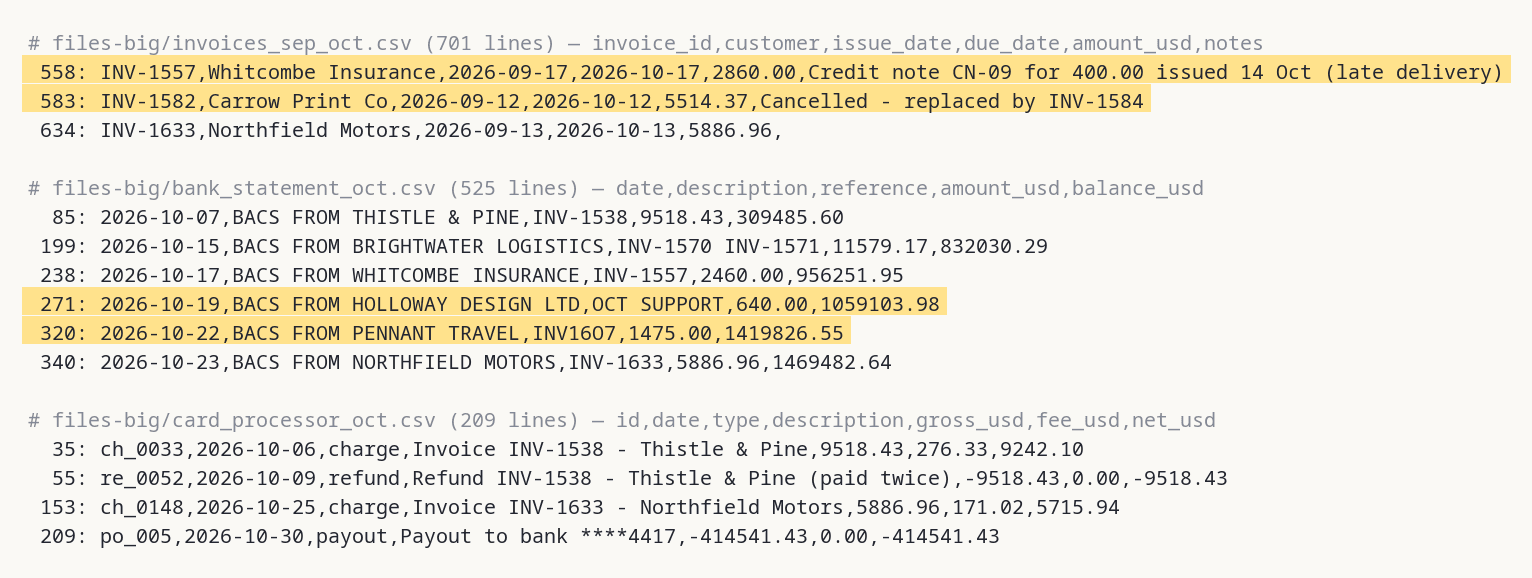
- The job: close October for a small agency from three CSV exports: the invoice list (September and October invoices), the October bank statement, and the October card-processor report. Ten questions: how many invoices are still open, the total customers owe, the overpaid invoice and by how much, the card payout still in transit and its amount, total card fees, the biggest debtor and what they owe, and the bank receipt that matches no invoice.
- Ten traps, none hinted in the prompt: a partial credit note written in the notes column; a cancelled invoice; three international transfers short by a wire fee (the rest is still owed); a payment with a typo reference (letter O for zero); one transfer paying two invoices; a half payment "on account"; an invoice paid twice and refunded; an invoice paid twice and not refunded; a card payout created on Friday 30 October that reaches the bank on Monday; and a deposit from a company with no invoice.
- Tools, not a pasted file: the models never saw the files whole. They got three tools:
list_files,read_file(at most 25 lines per call) andcalculate(exact decimal arithmetic). The agent loop ran until the model stopped asking for tools. - Two sizes: round 1 had 140 invoices and about 300 rows across the three files (13 reads at minimum). Round 2 was sealed after round 1 came back perfect. It hid the same traps in 700 invoices and about 1,430 rows (58 reads at minimum), with the trap invoices moved deep into the file.
- Scoring (code, not AI): one point per question, numbers to the cent, and the reply must parse as one JSON object.
- Models:
claude-fable-5-1,claude-opus-5-5andclaude-sonnet-5-5at their defaults (no effort or thinking setting), three runs each per round. We stopped Fable after one run in round 2. That run cost $3.74 and scored 10/10, and two more runs would have added about $7.50 without changing the conclusion. - Cost: tokens × list price, with prompt caching on, because that is how an agent loop is run for real: each turn re-sends the whole conversation, and cached tokens are billed at a fraction. Prices per million tokens: Fable 5.1 $10 in, $50 out, $0.25 cache read; Opus 5.5 $4, $20, $0.20; Sonnet 5.5 $2, $10, $0.10. Cache writes are billed at 1.25× input, and output includes thinking tokens. The English rounds cost $11.58 in total (round 1 $2.93, round 2 $8.65). One more Opus run in round 2 was cut off by a shell timeout before it saved a result and was rerun; its partial cost is not in that total.
The results
| Model (default settings) | Round 1 scores (3 runs) | Round 1 median time / cost | Round 2 scores | Round 2 median time / cost | Round 2 turns |
|---|---|---|---|---|---|
| Claude Fable 5.1 | 10, 10, 10 | 85 s / $0.70 | 10 (1 run) | 370 s / $3.74 | 81 |
| Claude Opus 5.5 | 10, 0*, 10 | 52 s / $0.20 | 10, 10, 10 | 189 s / $1.02 | 19–22 |
| Claude Sonnet 5.5 | 10, 10, 10 | 30 s / $0.087 | 10, 10, 10 | 157 s / $0.56 | 11–17 |
* All ten answers were right, but the reply contained two JSON objects (see below), and the sealed scoring code reads only one.
Where the models differed
None of the ten traps separated the models. Every model excluded the cancelled invoice, applied the credit note, matched the typo reference by customer and amount, saw that one double payment had been refunded and the other had not, and found the payout that had not reached the bank. Differences showed up in how they worked and in how they reported.
How they used the tools. Sonnet and Opus planned the reading: the first turn listed the files, and the next few turns asked for 8–10 pages at a time. Fable read sequentially in two of its four logged runs, one page per turn: 18 turns in round 1 and 81 turns in round 2, against 11–22 turns for the others on the same files. It reached the same answers, but an agent loop pays for every turn, and a 1,430-row job took Fable over six minutes against under three for Sonnet.
How they reported. The prompt asked for "only a JSON object". Fable and Opus often added notes anyway, and the notes are the useful part for a finance team. Opus in round 2 listed each judgement call with its effect on the totals: "If finance writes off the three small shortfalls, the count drops to 111 and the total to $527,322.32." Fable listed every adjustment under "Notes on how I got there, so you can check my judgement calls". Sonnet gave plain JSON in round 1. In round 2 it added a warning that it had "added up the figures by hand from the three exports, so a missed or misread line is possible". It had in fact used the calculator tool 21 times.
The one failed run. In Opus run 2 of round 1, the model sent a JSON object with nine keys, then wrote "Sorry, that's only nine keys. Here is the full object with all ten" and sent the full object. All ten numbers in the second object were right. The sealed scoring code expects one object and scored the run 0. If a script reads your agent's output, check that you get exactly one object back.
What worked
What worked
- Every model read every line of all three files in every run. The logs record which lines each model read, and none skipped a page.
- The ten traps cover what month-end reconciliation usually throws up, and every model handled all ten.
- Prompt caching kept the long loops cheap. Fable's round 2 run would have cost roughly ten times as much without it.
Where it fell short
What didn't work
- The test did not separate the models on accuracy. Making the files five times larger did not either. A harder job might separate them: messier formats, missing data, or a task where the model has to choose its own method. We have not measured that. Our messy sales sheet test of GPT-6.1 Terra, Astra and Fable 5.1 is one where Fable did drop a point, on a single ambiguous cell.
- The wire-fee shortfalls are a judgement call (chase the customer, or write the fee off), and our key counts them as still owed. All three models agreed in English. In our Vietnamese version of the same test, which we ran for our sister site, two of three Sonnet runs wrote them off and lost two points each, and said so in their notes.
- Fable in round 2 is one run, not three, so its round 2 numbers show what one run cost, not a typical range.
FAQ
How much does Claude Fable 5.1 cost?
Anthropic lists Claude Fable 5.1 at $10 per million input tokens and $50 per million output tokens, with cache reads at $0.25 per million. In our test, one agent run closing a small month (about 300 rows) cost a median $0.70. A run five times the size cost $3.74, with prompt caching on.
Is Claude Fable 5.1 better than Opus 5.5 for agents?
Not on this job. Fable 5.1, Opus 5.5 and Sonnet 5.5 all found the same ten traps in every scored run. Fable cost 3.4 times as much as Opus in round 1 and 3.7 times in round 2, and it was the slowest, partly because it read one page per turn.
When should I pick Fable 5.1?
Anthropic's own guidance is to use Opus 5.5 for most workloads and to move to Fable 5.1 "when your evals on Claude Opus 5.5 at higher effort still fall short". Our results fit that advice. Run your own task on Sonnet or Opus first, and pay for Fable only if they fail it.
Our verdict
For a month-end close with tools, we would not use Claude Fable 5.1. Anthropic describes Fable as built for long-horizon agentic work, and this was such a job: 58 page reads, 10 traps, numbers to the cent. Sonnet 5.5 gave the same answers for about an eighth of the cost in round 1 and a seventh in round 2, in less than half the time. If you work in Claude, start agent jobs like this on Sonnet 5.5. Opus 5.5 explained its judgement calls most clearly in our runs, so it is the step up if you want that, and keep Fable for jobs where both of them fail. Whatever model you use, ask it to list the calls it made (written-off fees, overpayments) next to the numbers, because those notes are what a person checks before closing the month.
How this was made: an AI (Claude) helped write this article; the RanThis editor ran the test script, checked every number against the raw results and checked facts against the linked sources.
Sources
- Claude Docs – Models overview: Fable 5.1 'for demanding reasoning and long-horizon agentic work'; Opus 5.5 for most workloads (read 28 Oct 2026)
Vendor document
- Claude Docs – Pricing: Fable 5.1 $10/$50, Opus 5.5 $4/$20, Sonnet 5.5 $2/$10 per 1M tokens; cache read prices (read 28 Oct 2026)
Vendor page
- Claude Docs – Prompt caching: 5-minute cache writes cost 25% more than base input (read 28 Oct 2026)
Vendor document