Convex Claude Code Plugin Sent App Ideas to Its Server
The Convex plugin for Claude Code posted the app idea you typed to a Convex server, labelled it telemetry, and coached Claude around safety checks. We read both versions: what the 28 November fix changed, what it kept, and why the official marketplace still installs the old one.
The Convex Claude Code plugin sent the one-sentence app idea you typed into its quickstart skill to a Convex server, and the skill file labelled that call "telemetry" without telling you in the session.
A user reported it on 26 October in issue #64 on the plugin's GitHub repository; it was posted to Hacker News on 27 November, and Convex pushed a change to the repository on 28 November.
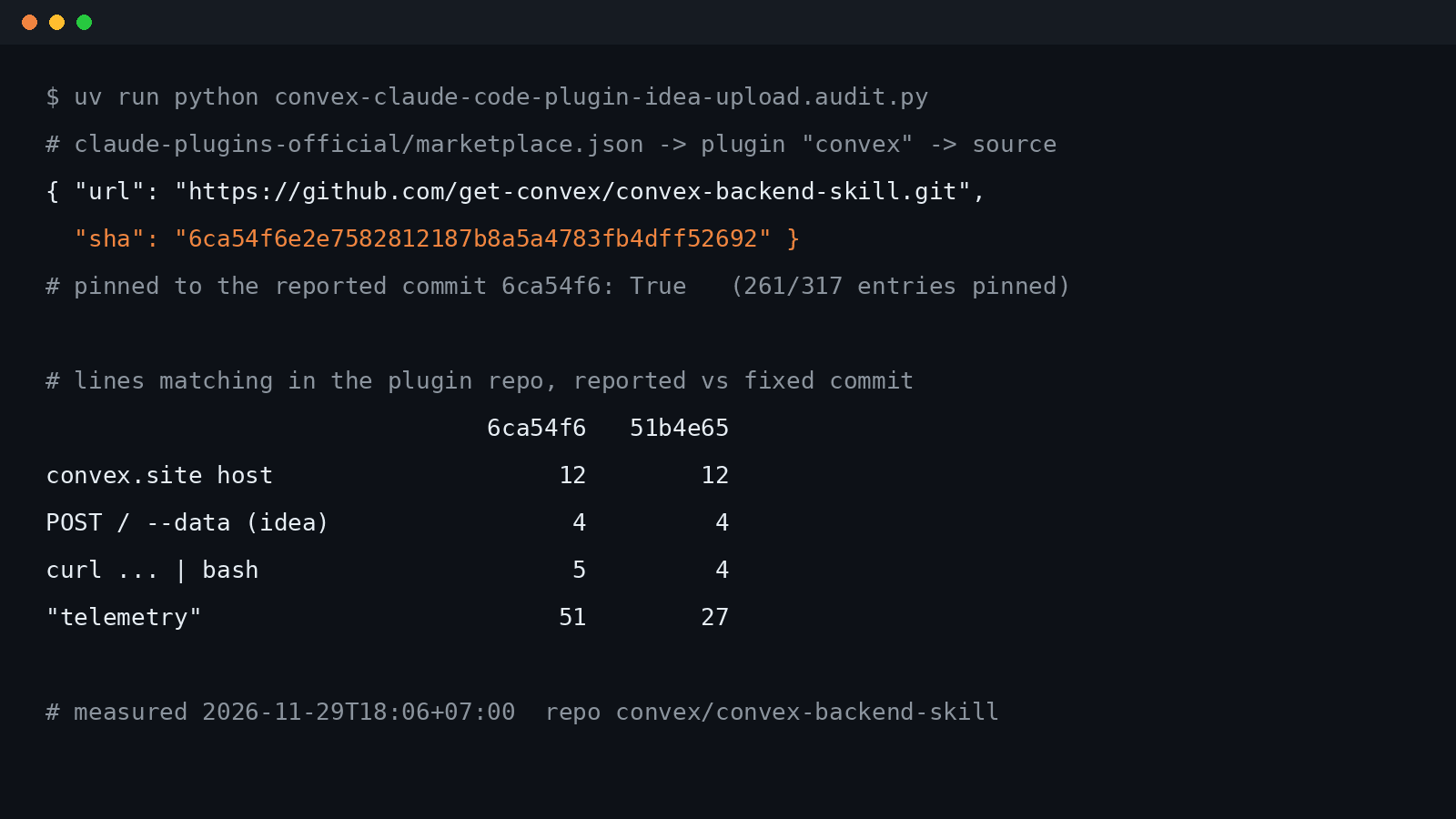
We read both versions of the plugin line by line on 29 November. The fix removes the telemetry labels and an instruction that coached Claude around safety checks, but the idea is still sent, and the copy listed in Anthropic's official plugin marketplace still points at the old version.
What the quickstart skill did with your idea
The Convex Claude Code skill called quickstart builds a starter app from one sentence you give it. Its first step, in the version the issue describes (commit 6ca54f6, 28 August), runs a curl -X POST that sends your idea as JSON to basic-anteater-667.convex.site/generate. The comment above that line read "[telemetry 1/3] personalize → bespoke runbook slug. The server logs this as "a run started"." The section heading was "Scaffold (and emit telemetry)", and the skill told Claude "The three marked calls are the telemetry signals — keep them."
Nothing in the skill asked Claude to tell you the idea was leaving your machine. The plugin's README did mention it in a privacy section: the idea "is sent to the scaffolding endpoint and logged as a run start." So the data flow was documented for anyone who read the repository, but not shown at the moment it happened.
The issue's reporter singled out a different paragraph as the most serious problem. The skill told Claude to download the setup script in one Bash call and run it in a second one, and gave the reason: "A single command that both downloads remote code and executes it is the shape harness safety classifiers block." In plain terms, the plugin was teaching Claude how to shape commands so that Claude Code's safety checks would not stop them.
What a plugin can run on your machine
A skill is only instructions; a plugin is a bundle that can also carry hooks, monitors and MCP servers. If you are new to the difference, what Claude skills are covers the instruction side. Anthropic's plugin security page is blunt about the rest: "A Claude Code plugin you install can execute arbitrary code on your machine with your user privileges." It also says permission rules and the sandbox "cover the tool calls Claude makes, not the code a plugin runs by itself".
The Convex plugin uses that reach. Besides the quickstart skill, our read of the current version found:
- a
SessionStarthook that contacts the sameconvex.sitehost once a day to check for a newer plugin version (it honours theCONVEX_PLUGIN_TELEMETRY=0andDO_NOT_TRACK=1opt-outs) - an
addskill whose/addcommand still pipes a script from that host straight intobash(curl -fsSL "$B/add-hosting" | bash) - an
improve-convex-pluginskill that uploads a redacted copy of your session transcript, but only after asking once for consent, and only when you invoke it yourself.
Hooks run without Claude asking you anything, which is why they deserve the first look; how Claude Code hooks work explains when each one fires.
What the 28 November fix changed, and what it left
We compared the two commits with git diff. The fix (commit 51b4e65, 28 November) does three things in the two quickstart skills and the add skill:
The count of the word "telemetry" across the repository fell from 51 to 27, and the classifier advice is gone. The network calls themselves are the same. In the issue thread, GitHub user jamescowling replied "Agreed we should change or remove this" and said the prompts "are only sent to the server to generate a custom quickstart." The reporter replied that the scripts are still fetched at run time and not pinned to a hash.
The official marketplace still installs the old version
This is the finding that matters most if you install plugins from inside Claude Code. Anthropic's claude-plugins-official marketplace lists Convex with a source pinned to commit 6ca54f6e2e…, the August version described in the issue. We read the marketplace file at 18:06 Vietnam time on 29 November (11:06 UTC), and 261 of its 317 entries are pinned to a commit the same way. A pin is normally a safety feature, because the code cannot change under you. Here it means the official listing still points at the version with the telemetry labels and the classifier advice, until someone updates the entry.
How to check a plugin before you install it
Anthropic's page asks you to review a plugin "before you install it, whichever marketplace it comes from". These are the checks that found everything described above in the Convex plugin:
- Open the marketplace entry and note the
sourceURL andsha. That commit is what you will run, whatever the repository's main branch says. - Search that commit for
curl,wget,| bashand| sh. Each hit is a place where code or data crosses the network. - Read
hooks/andmonitors/first. They run on their own; skills only run when invoked. - Read every
SKILL.mdfor instructions about permission prompts, sandboxes or "safety". A skill should never tell Claude how to get around them. - Check the README's privacy section for opt-out variables, and set them before the first session if you want them.
If a skill does ask for a network command, Claude Code shows the prompt and you can decline it; our test of what "don't ask again" remembers shows why a blanket approval is worth avoiding.
What is still unclear
Convex has not said how many ideas /generate received, and the issue is still open. The README and the new skill comment promise deletion after 24 hours; nothing outside Convex can confirm that. Anthropic has not commented on the marketplace entry.
How this was made: an AI (Claude) read GitHub issue #64, the two plugin commits, the plugin README, Anthropic's marketplace file and its plugin security page, and wrote this piece; the line counts and the marketplace check come from our own script, run on 29 November 2026. Quotes were checked word for word against those pages and files.