Claude Opus 5.5 vs Gemini 4 Argon: 7× the cost, and the only model that caught our wrong date
Same three office tasks through both APIs: Argon passed 15/15 for $0.00679, Opus 5.5 passed 10/11 for $0.04790, and lost its point by flagging a real error in our test data.
By the RanThis team, written with AI assistance7 min read
Why trust this: every result, number and screenshot comes from a real run on our own accounts, not from the AI. How we test
In our Claude Opus 5.5 vs Gemini 4 Argon test, Argon passed every check, ran faster and cost about a seventh as much: $0.00679 for three office tasks against Opus's $0.04790. Opus lost one point, and the reason is the most interesting result of the series so far: it was the only model, out of six we have run on this task set, to notice that our own test data had a wrong date in it.
Tested on 16 October 2026, calling the Anthropic Messages API with
claude-opus-5-5and the Gemini API withgemini-4-argon, each at its default settings. Each task ran once, so this is a real-world observation, not statistics. The tasks use made-up data. Prices come from the official pricing pages on the day of the test.
The test was run in Vietnamese: the tasks, the made-up data (amounts in Vietnamese dong) and the model replies are in Vietnamese, as are the terminal screenshots below. It uses the same three tasks and the same grading code as Claude Haiku vs Sonnet and Gemini 4 Argon vs Flash.
At a glance
Key results
- Accuracy: Gemini 4 Argon 15/15 checks passed. Claude Opus 5.5 10/11: our grader marked its invoice answer "not valid JSON" and stopped there.
- Why Opus failed that check: its JSON was correct, but it added a note after it: the due date in the email, "Friday next week, i.e. 24/10/2026", is wrong, because 24 October 2026 is a Saturday. It is. None of the other five models we have tested on this task (Haiku 5.5, Sonnet 5.5, Gemini 3.8 Flash, and Argon in two runs) mentioned it.
- Speed: Argon 15.7 seconds for the three tasks, Opus 21.4 seconds.
- Cost: Argon $0.00679, Opus $0.04790, about 7.1×.
- Caveat: Argon's introductory price doubles on 1 December 2026 to the same list price as Opus. At that price this run would cost Argon about $0.0136, so Opus would still be roughly 3.5× more, because it used far more output tokens.
Claude Opus 5.5 vs Gemini 4 Argon: pricing and specs
| Claude Opus 5.5 | Gemini 4 Argon | |
|---|---|---|
| API model id | claude-opus-5-5 | gemini-4-argon |
| Input price (per million tokens) | $4 | $2 (introductory, until 30 Nov 2026), $4 from 1 Dec 2026 |
| Output price (per million tokens) | $20 | $10 (until 30 Nov 2026), $20 from 1 Dec 2026, thinking included |
| Context window | 1 million tokens | 1 million tokens (per Google's model docs) |
| In the consumer app | Claude Pro, Max and Team plans (not Free) | Google AI Pro and Ultra subscribers |
Sources: Claude models overview, Claude pricing, Gemini API pricing and Google's Gemini 4 Argon availability post. The Gemini API pricing page says Argon is not available on the API's Free tier or on the Google AI Pro plan; the app is a separate surface.
Hands-on test
How we tested
- Three office tasks, identical to the earlier tests, with answers worked out before running:
- Invoice extraction: read a messy email and return invoice details as JSON. Traps: a mistyped amount that was later corrected, a former company name, a due date written in words.
- Tiered commission: sales commission for 5 staff at 2% / 4% / 6% by band, plus a bonus for sales of 150 million dong or more with no returned orders, with edge cases at exactly 200 million, at 149.5 million and with one returned order.
- Customer reply: an apology for a late order, at most 120 words, with a 10% discount code, no promised delivery date, ending with the hotline.
- The same prompt sent to each model through its own API, default settings, no system prompt.
- Code grades every item: a valid-JSON check plus 5 invoice fields, 6 commission figures, 4 email conditions. If the JSON check fails, the 5 field checks are skipped, which is why Opus has 11 items instead of 15.
- Real measurements: time from request to response, token counts reported by each API, and cost from the price lists.
Results task by task
Task 1: extracting invoice details
Both models wrapped their JSON in a code block, which the grader accepts. Argon got all 5 fields right in 4.2 seconds. Opus took 6.4 seconds and had the same correct values: tax code, pre-tax amount of 12,450,000 dong (not the mistyped figure), 8% tax of 996,000 dong, total of 13,446,000 dong, due date 2026-10-24. Then, outside the block, it wrote:
Note: 24/10/2026 is a Saturday, not a Friday. The Friday of that week is 23/10/2026. The JSON uses the date written explicitly in the email (24/10). You should confirm with the sender before issuing the invoice.
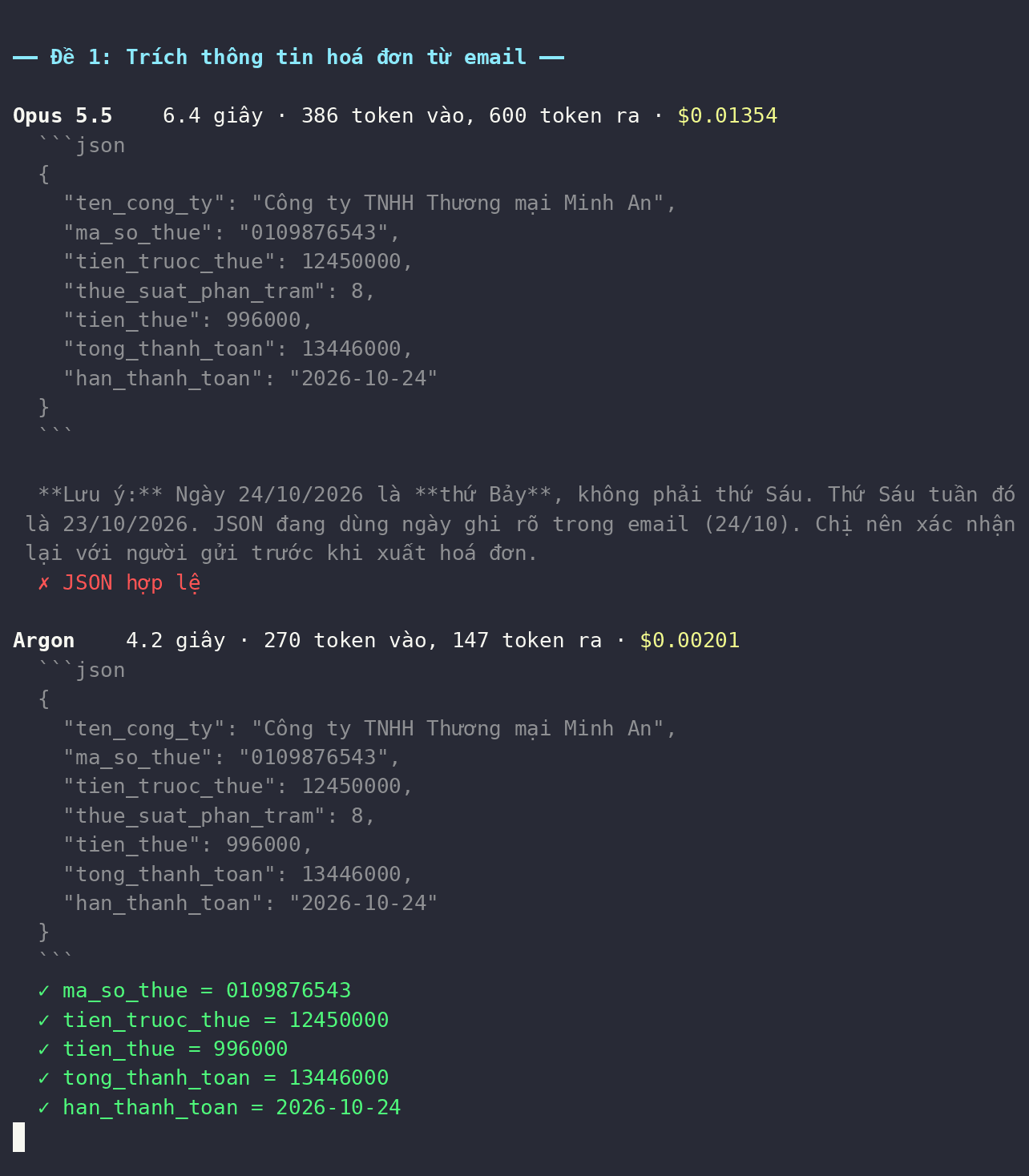
We wrote that email for the first test in this series and never noticed. Strictly, Opus broke the "return JSON" instruction, and our grader is strict, so the point stays lost. In a real accounts workflow, though, that note is the most useful sentence any model produced in this series. Whether you want it depends on your pipeline: a parser that expects bare JSON will fail on it, a person reading the answer will thank it.
Task 2: tiered sales commission
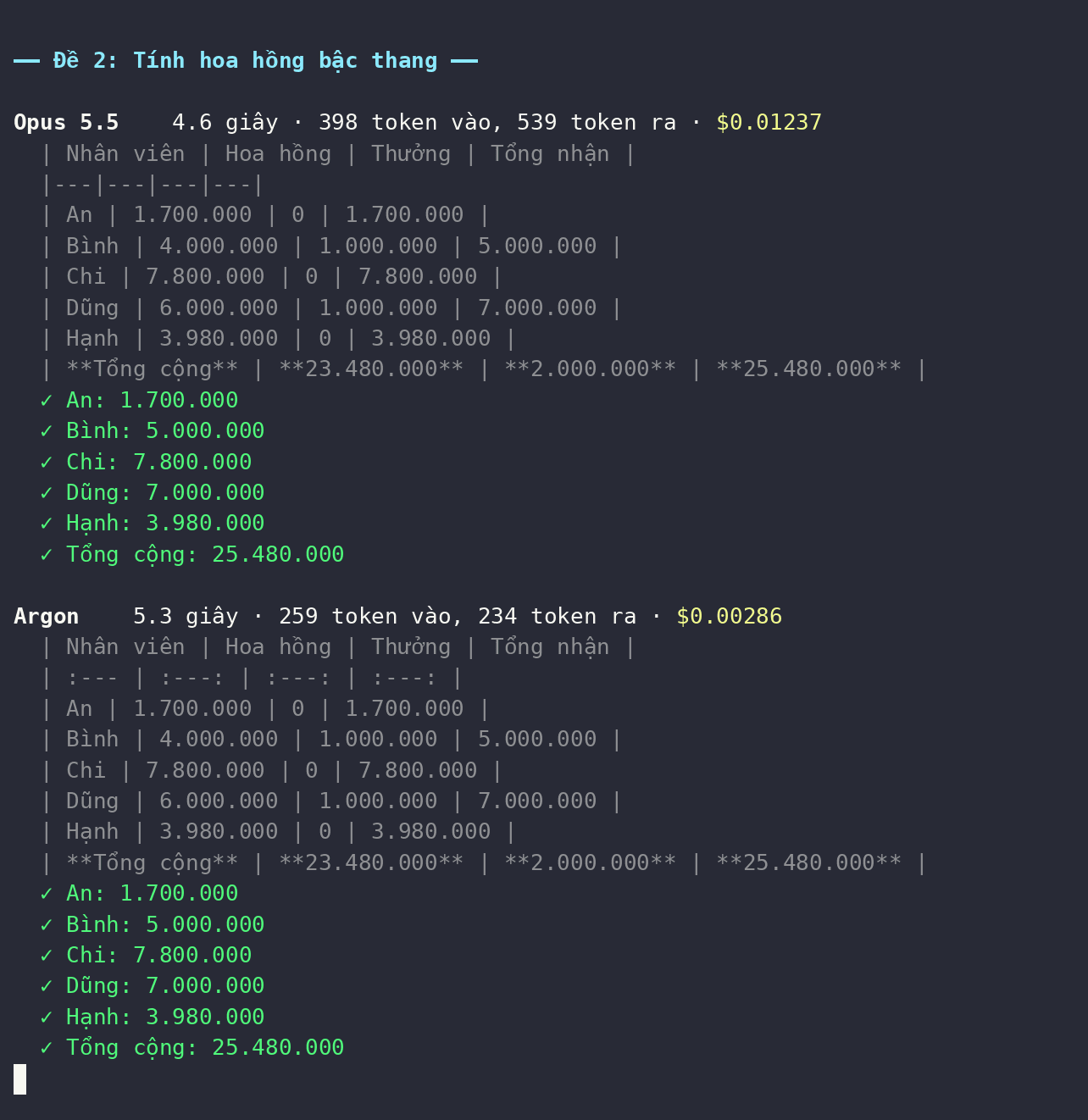
Both models got all 6 figures right, and neither gave the bonus to the person 500,000 dong short or to the one with a returned order. Opus answered in 4.6 seconds, Argon in 5.3: the only task where Opus was faster.
Task 3: replying to a customer
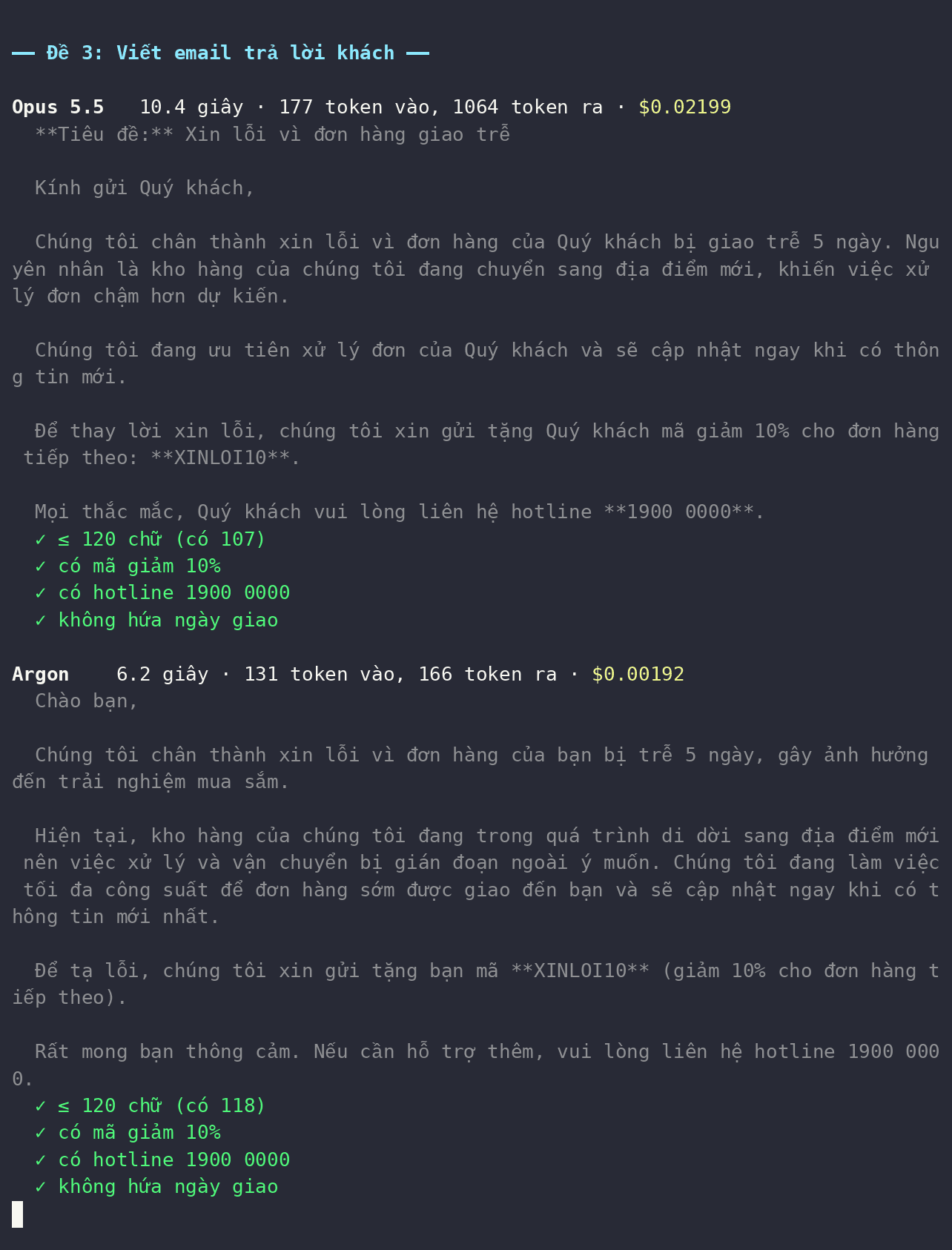
Both emails met all 4 conditions: Argon's was 118 words, close to the 120-word cap, Opus's 107. Opus took 10.4 seconds and reported 1,064 output tokens, against Argon's 6.2 seconds and 166 tokens. Claude 5.5 models count thinking in their output tokens; in our Haiku vs Sonnet test the same email task also used around 900 output tokens.
Totals
| Model | Checks passed | Time | Cost |
|---|---|---|---|
| Claude Opus 5.5 | 10/11 | 21.4 s | $0.04790 |
| Gemini 4 Argon | 15/15 | 15.7 s | $0.00679 |
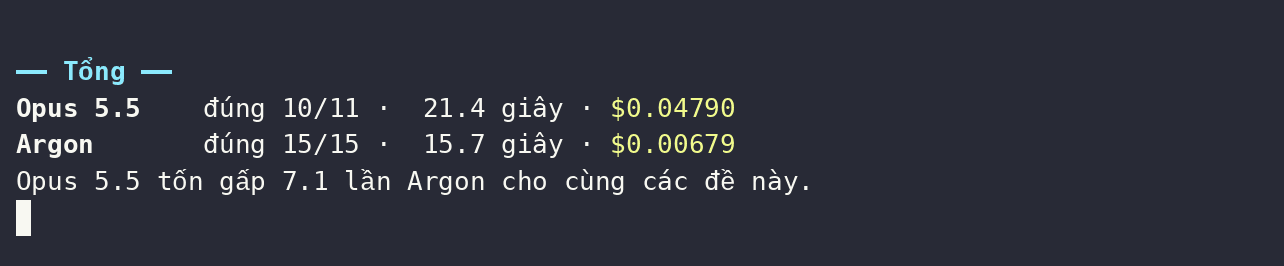
Opus produced more output tokens on every task (600, 539 and 1,064 against Argon's 147, 234 and 166), and it also read the same prompts as more input tokens (for example 177 against 131 on the email task). That is most of the 7.1× gap; the 2× difference in list price is the rest.
Which one should you use?
- Fixed-format extraction at volume (invoices, forms, anything a parser reads): Argon in this run, and it is much cheaper until at least 30 November. If you use Opus, ask for JSON only and validate it, because it may add notes.
- Work a person will read and act on: Opus's habit of flagging something wrong in the source is worth paying for when a mistake costs more than a few cents.
- Not tested here: long documents, coding, multi-step agent work, or more than one run per task. Treat this as one careful observation, not a benchmark.
FAQ
Is Gemini 4 Argon cheaper than Claude Opus 5.5?
Per token, Argon is half the price until 30 November 2026 and the same price after that. In our three tasks it was about 7× cheaper overall, because it also used far fewer tokens.
Which is more accurate, Opus 5.5 or Argon?
On these three tasks Argon passed 15/15 checks and Opus 10/11. Opus's only miss was format: it added a correct warning about a wrong date after its JSON.
Can I use Gemini 4 Argon for free?
Not through the API: Google's pricing page says Argon is not on the Free tier. In the Gemini app, Google lists it for Google AI Pro and Ultra subscribers.
Is Claude Opus 5.5 available on the free Claude plan?
No. Claude's pricing page lists Opus on the Pro, Max and Team plans, not Free.
Sources
- Anthropic: Claude models overview (Opus 5.5 pricing, context)
Vendor document
- Anthropic – Claude pricing page (USD, before tax): Free/Pro/Max/Team, feature table, up to 1M context, no fixed message cap
Vendor page
- Gemini API — Pricing
Vendor page
- Google Gemini Blog: Gemini 4 Argon comes to the Gemini app.
Vendor page