1Password Breach: Vaults Safe, Names and Emails Taken
1Password says an attacker took over an employee's GitHub account, pushed malicious code to backend services and copied names, emails and account metadata for a subset of users. Vault contents were not accessed. What each leaked field means, why the vault stays locked, and what to do now.
1Password says an attacker copied account records for a subset of its users, including names and email addresses, after taking over an employee's corporate GitHub account. Vault contents were not accessed, and 1Password says you do not need to change anything in your account. The real risk for most users is phishing that now knows your name and email.
The company published its account on 25 November 2026 and promised a Root Cause Analysis (RCA) in the coming weeks, once its investigation is complete. This piece covers what 1Password has confirmed, what each leaked field means for you, and what is still unknown.
What 1Password has confirmed
The 1Password security incident came to light on 19 November 2026, when the company began investigating signs that an attacker had gained access to an employee's corporate GitHub account. According to the company, the attacker used that account to reach source code and push malicious code to backend services, and that code downloaded administrative data about customers.
The attacker also copied source code from private repositories and got into 1Password's CI/CD system, the pipeline that builds and ships its software. 1Password says the source code holds no user secrets, and that it has rotated all credentials that may have been exposed in CI/CD.
1Password lists these clean-up steps: it disabled the GitHub account, revoked the stolen token, tightened GitHub, CI/CD and endpoint controls, and brought in independent security experts to check the work. It also says it found no internal evidence of account takeovers using the exposed tokens. Its apps and services are working normally.
What each leaked field means for you
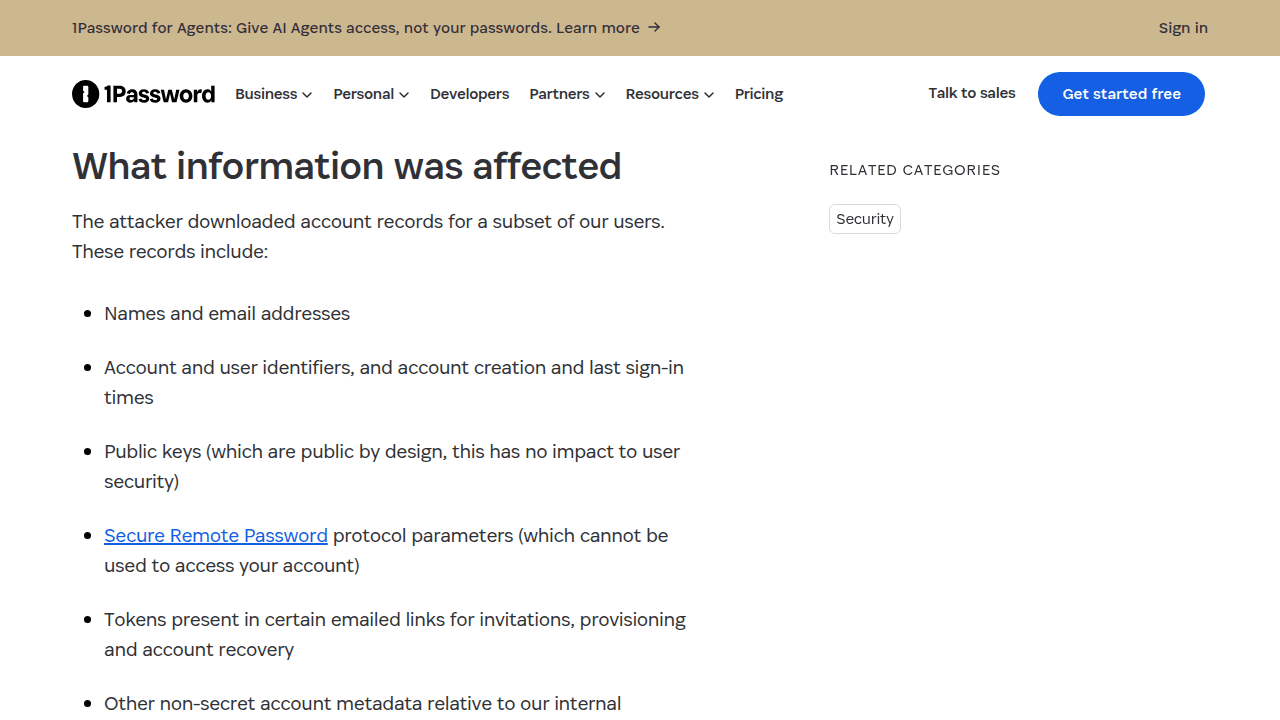
The company says the attacker downloaded account records for "a subset" of users. It has not said how many people, or which plans or regions. Here is the list from its post, with our reading of what an attacker can do with each item.
The token row is the one 1Password changed its product for. A provisioning invite is used by its SCIM Bridge and Hosted Provisioning, which companies use to add staff automatically. The token alone cannot open an account, but it was paired with a six-digit code. 1Password has now expanded that code to ten letters and numbers so it cannot be guessed.
1Password's breach notification, as the post describes it, went to one group: the small number of users who had a pending invite or recovery during the incident were notified directly. The post does not say whether other users in the affected subset will get an email.
Why your vault stays locked even if the servers were breached
The data that would matter most, your vault, was not touched, and the design explains why. 1Password combines your account password with a Secret Key to build the key that encrypts your vault. Neither is ever sent to 1Password's servers. Its Secret Key support page says the key has 128 bits of entropy, which makes it infeasible to guess, and that a brute-force attack on its servers cannot decrypt your data without that key.
So the SRP parameters the attacker took do not give a shortcut to your vault. The weak point is you: if a phishing page tricks you into typing both your account password and your Secret Key, the protection is gone. That is why 1Password's advice centres on phishing, the same pattern seen when a malicious release of Microsoft's agent-framework package on PyPI went after developer credentials rather than breaking encryption.
What to do now
- Do not change anything just because of this incident. 1Password says no account update is needed.
- Be careful with any email, text or call that mentions 1Password, an invitation or account recovery, especially one you did not start.
- Never type your Secret Key into a page opened from an email. 1Password will never ask for your account password or Secret Key, and you only need the key the first time you sign in on a new device or browser.
- If you get an invite or recovery email you did not request, do not click it. Report it to [email protected].
- If you manage a 1Password Business account with SCIM provisioning, check whether you received a direct notice from 1Password.
What is still unknown
1Password has not said how many users are in the affected subset, how long the attacker had access before 19 November, or how the employee's GitHub account was taken over. It says it will publish a Root Cause Analysis once the investigation is complete, and that it will update the original post if anything changes. We will update this article when that write-up appears. Until then, read early claims about the attack the way we read the mid-November Microsoft, FAA and Chase outages: social media guessed at a coordinated attack, and the causes the operators later gave were bugs and a router change.
How this was made: an AI (Claude) read 1Password's incident post and its Secret Key support page and wrote this summary; the table's "what it lets an attacker do" column is our own reading. Every statement attributed to 1Password was checked word for word against its pages on 27 November 2026.